Showing posts with label Ad. Show all posts

Wednesday, March 4

global march with Uniqlo

With H&M hitting Japan last September, UNIQLO is battling its toughest competition yet. At the same time, it is aggressively expanding its international store network in New York, London, Paris, Hong Kong, Seoul, Shanghai and Beijing. With its latest global campaign, put together by GT Tokyo it aims to connect with people across every age group, in every country that the brand is available… a very ambitious task.

UNIQLO March is an online ‘presentation’ format showing a group of 33 people spanning a wide range of ages, sex and occupations marching across the screen. Footage was filmed with an ultra-wide RED ONE lens, never used for online content before. The lens allows video footage of scenes covering more than 50m in length. Viewers can interact with the marching group to make them run, walk backwards or wave at each other.

By clicking on an outfit that they like, users can see a profile of the marcher and get taken directly to the online store to purchase any of the items the model is wearing. Users can also choose to keep their involvement online as an icon in a virtual Google Maps march through the streets of Tokyo or apply to take to the ‘real world’ streets as a model for the next element of the campaign.

via Contagious Magazine

www.uniqlo.com/march

Fiat Adventure


New ad by Leo Burnett Argentina for Fiat. Photo by Juan Mathe

fiatoffice

fiathome

fiatfiling

via Fubiz

Thursday, January 15

The Right Kind of Wrong


Installation view of The Right Kind of Wrong at Mother ad agency in London

Opening tomorrow night at Mother ad agency in London is an exhibition by graphic artist Anthony Burrill and product/furniture designer Michael Marriott.


The Right Kind of Wrong is on show Mother until February 6. Visits must be booked by appointment - call 020 7739 8985. Burrill and Marriott’s sculpture will also be on show at this summer’s Village Fete at the V&A.

via CR blog

Tuesday, July 8

Tea, Tennis, Faceless Aliens at Wimbledon

Facelesspeople404_684376c

As the 2008 Wimbledon fortnight played itself out, the event offered all of its traditional trappings -- immaculately mown grass, clean yellow tennis balls, breakfasts of strawberries and cream and well-dressed faceless alien androids.

The creepy spectators (above) had already showed up at Harrod's and other spots around London, but their persistent pop-ups at the All-England Tennis Club were by far their most public appearances. A couple of the world's more ingenious media outlets reported that the figures weren't really faceless and had pinholes in their masks for the actors' eyes.

It was a viral marketing stunt -- about the anonymity of humankind in the information age.

Lotus set up this countdown website as part of this manufactured ex-mystery.

Lotus, The Question wants his gimmick back. So does The Blank.

By John Scott Lewinski

via cherry flava, underwire

Image courtesy Splash, BBC News

Monday, February 25

News from ICONEYE

KesselsKramer Outlet


More chip shop than office, the new London base of Dutch communications agency KesselsKramer, designed by FAT, is decorated with white tiles and steel counters.

“KesselsKramer wanted the space to be accessible to the public, they didn’t want to be closed off like many offices are,” says Tomas Klassnik, FAT’s project architect. “You often have a receptionist at the front who can look quite imposing.”

Lured in by the promise of deep-fried sea creatures and pickled eggs, visitors will instead find themselves in a shop selling the agency’s books. But they can also explore further. “The idea was that the public would also be able to walk through to, basically, where the designers are working,” Klassnik explains.

Behind the shop area is a gallery space, and visitors can wander even deeper into the offices. A wooden partition with large moving sections bisects the rear areas, separating work and gallery areas. The moving sections mean the space can be reconfigured to allow for more space or more privacy.

“It’s quite an unusual space to work in,” says Klassnik. “Because there’s that ambiguity of closure, it doesn’t feel as corporate as it might.”

The office, in Hoxton, east London, is KesselKramer’s first outside the Netherlands.

images Timothy Saul


via ICONEYE

Tuesday, January 22

Leo Burnett Predicts the Year Ahead

The folk at Leo Burnett UK have presented their thoughts for the advertising industry in 2008, and kindly let PSFK sneak an early peek. No big shockers in the document, but Ben Hourahine, Leo Burnett’s Future’s Editor, has summarised 8 trends that collectively see this year as being the one where people see a real change finally hitting the mainstream; where the industry wakes up to the power of the community and starts to understand the value of branded utility.

Leo Burnett 2008 predictions:

Mass is back (Say hello to the Swell Society)
The power of mass culture will be back in 2008. At the turn of the year online downloads were included as part of the UK Christmas pop chart for the first time ever. This trend of online popularity being institutionalised shows that mass appeal will once again define marketing attitudes. Where once the watch-words were fragmentation and micro-targeting, Google, YouTube and Del.ici.ous are new gauges of mass appeal, a fact marketing will wake up to this year. The goal is the same; reach a mass audience, the difference is how to achieve it. Say hello to the Swell Society. How do you create ‘swells’ in pop culture when the audience is not necessarily captive and waiting in the first instance? How do you make sure that your film or viral grabs a spot in YouTube’s top ten guaranteeing the attention of millions? The marketing means maybe changing, but the objective is the same.

Community Commerce

Community connections will become more central to business practice in 2008. Retailers will seek to bring the community further inside the store, with more coffee shops, banking services and pharmacies within supermarkets. On top of this, a revolutionary development in the relationship between commerce and society will take place this year, when Sainsbury’s opens a police station inside its Fallowfield store in Manchester . On the other side community connections are being used to create new businesses for established brands. The Sun newspaper online bingo community was set up in 2005 and is now the biggest Internet game in the world . From an experimental brand-stretch three years ago, the community is now News Corps biggest digital cash cow . Expect to see more established brands following suit this year. You never know, we may see Bisto using its family connections to become the new Butlins in 2008!?

Screen Saturation

2008 will see the explosion of screen-based media, with screens on the side of buses, in petrol station, supermarkets, the home and the pocket. While the medium may remain the same, the reach, context, audience and role of the media will be tweaked. There will be more broadcast screens than ever in 2008 and things are only going to get bigger: According to Sharp - the electronics manufacturer - the average television screen size will be 60” by 2015

Gender Reversal

More women in work and the increasing role played by men within the family will see marketers change their focus this year. Three years ago the Office For National Statistics discovered that women outstripped men in UK further education enrolment , which means most will be graduating this year and looking to enter the work force. Men’s interest and investment in the family will continue to rise as well, morphing the gender balance and changing the advertising context. In 2008 expect to see more and more campaigns aimed at women at work and men in the home. With gender differences diminishing, new forms of identity will be emerging in 2008.

Brand Guardians

The role of brands is evolving and will enter a new phase in 2008. With growing concerns over how to be healthy, safe and happy, mixed with a real confusion about how to achieve this, we will see brands increasingly attempting to take on a guardian role this year. Forward-thinking policies, honest brand ethics and a general ethos of wellbeing and comfort in one's choices will be promoted by the most leading-edge amongst them. We have already seen the beginning of this trend with campaigns like Kellogg’s Bran Flakes’ ‘Three Step Program’ and Pedigree’s ‘Adopt a Dog’ initiative, but as public confidence and trust levels continue to waver we will see a lot brands striving for guardianship status, making this a significant trend in 2008 and, indeed, perhaps years to come.

The brands of the future will live out the interests of their consumers. Consumers will help brands make their own lives better. We will then know our customers better than ever and, in turn, they will trust us to use their information to create a better future for both.

IP Idols

Artists are grabbing control of their creative product. Intellectual Property (creative works – ideas, songs, movies, TV shows) used to be owned and licensed by studios, record labels and other commercial institutions, but we will see artists back in the driving seat this year. At the end of 2007 Madonna signed to the Live Nation label, giving her unprecedented control over her albums, concerts, tours, merchandise, websites, DVDs, sponsorship, TV shows and films. Other IP idols will grow in power and commercial clout this year. Simon Cowell has shown himself to be bigger than the pop charts by taking over the Christmas number one spot via a TV show. You may not like him, but you wish you’d thought of it. The man has taken over an entire industry through success in another sector, proof of the power of IP Idols, even over entire media channels.

The Data Awareness Era

In 2008 the public will be more aware of their data exposure than ever before and privacy concerns will be a defining issue in 2008. Until now the disarming novelty on social networks, like MySpace and Facebook has generally overridden concerns about the potential hazards of full disclosure. That could change this year. High profile data leaks like the British Government’s recent loss of computer disks containing child benefit records have raised awareness of privacy issues. As more employers and university admissions officers troll social networks for potentially embarrassing revelations on candidates, users may decide that it is better to leave the Saturday night snap-shots in their mobile phones

Expect this trend to accelerate with the introduction of GPS location based information, the explosion in online information storage and social networking increasingly reflecting real life…

Social Networks Get Real

Social networks like Facebook , Bebo and MySpace have been virtual playgrounds for some time, but in 2008 they will start to plug directly back into the real world. This year we will see social networks beginning to dictate everyday life, influencing who people do business with, which parties, movies and gigs they go to, where they meet and with whom. Accelerating the shift to life itself being organised through Facebook or MySpace , is the advent and take up of mobile social networking: 14m people did it in 2007, and forecasts suggest it could hit 600m by the time the Olympics hits London in 2012 . Allowing people to participate on the move; mobile applications will turn Facebook and the like from a method of meeting old school friends to a real time diary of their very real lives. Never far off the pace, Google is rumoured to be launching ‘Google World’ this year, using Google Earth as the framework, this is the Internet giant’s answer to Facebook and Second Life. As the Ars Technica blog reports:

‘Google Earth CTO Michael Jones insisted… Google Earth would always remain true to the real world and not dive into the type of fantasy world that Second Life has become. Therefore, Google's implementation would be more like "First Life," but in virtual form.’

Social networks in 2008 will no longer be simply voyeuristic frivolities; they will help us participate in actual activities with our existing friends and acquaintances, in real life, with sunshine, colour, oxygen and everything.


PSFK

Leo Burnett

Wednesday, November 7

Behind the Scene: Seemingly Unlimited Effort for Unlimited Orange

via Creativity

Poke, London explores the endless possibilities (and massive effort) in creating the UK brand's site.

While plenty of websites can feel infinite for all the wrong reasons, Poke London's colorful online creation for UK brand Orange is in fact designed as an authentic unlimited excursion, guiding visitors on a winding rainbow through a quirky, creature/activity-filled path that can absorb plenty of eyeball time.


Inspired by Orange's tagline that "good things should never end"—which is the foundation of the mobile brand's latest promotion—the site features mischievous-looking animals/ghosts/beings buzzing about along with a host of modules for people to play with and leave a mark forever. And with a constantly evolving landscape as its main ingredient, Poke, London obviously had its work cut out from the start. "It was massive, and [technically], it was managing all that stuff so that it doesn't crash, including the way the modules were loaded in and out," Poke creative director Nick Roope explains. "We brought in [visual designer] Marius Watz and guided him about how we wanted this rainbow to grow. We brought in an illustrator, Rex, who did the little black animations. We assembled all these different people, and we had all these different elements, and there was a massive management process to bring them all together. We had to load the [elements] in and out of memory as to when they were needed because if you've been scrolling down for 20 minutes and it's a whole 20 minutes worth of different things in memory, then it would at some point crash."


By installing user interaction outlets at virtually every twist and turn, the Poke design team covered a big loading process with little loading processes which contain fun challenges. "The user would have to interact with the modules to get them to load in the first place," says Roope. "But each module has its own creative mood that presents a challenge because you have to keep people engaged while loading so the fact that they feel like they're activating these things is a [feature] and they are reacting—but the [content] isn't fully integrated necessarily straight away. Then, obviously, in order to continue scrolling on the wall, people have to close those things down so that's one way we're managing it. Then, as you're scrolling down the pages, [the system] is obviously remembering where some things are, so it's randomly dropping things in and then unlearning them as you've passed."

Poke was also pulling double duty with the audio/sound design, first enlisting the services of BAFTA award-winning composer Nick Ryan to create the chirps, hyper-electro beats, revving motors and host of other noises. Next, the group had to insert and mix the sounds while considering the spatial aspects of the site. "We [needed] to know what's both directly on the screen and what's in proximity to it so we can start to play with the sound quality—usually it was 3D sound that's [ideal] for gaming—to create some of the audio effects so that you start hearing a sound before you see something. But then, obviously, the quality of the sound changes. It's creating the impression that it's an audio landscape as well as visual."

A landscape-styled creation is what Roope and company intended during the nearly three-month process to develop Orange's site, which the creative director understandably says is "...the most expensive one-page website I think I've ever worked on." Blending puzzle games, creature interaction, and other odds-and-sods time-killers with the slightest of branding (besides a few playful links scattered about), Roope emphasizes that the site concept is in line with Orange's mantra. "The whole idea of it is to communicate the notion of 'unlimited, ultimately.' That's why the client has financed it, because it's ultimately talking about the adventure of some of their products. We've very consciously tried to build that notion in to everything that we've done, but also in a very much more poetic way."


The CD counts among his personal favorite activities on the endless adventure to be the ice cream maker (pictured). "You're invited to create an ice cream, so you rapidly generate ice cream out of different [flavors] and toppings. You can control it to a certain extent, but it's random like a slot machine. Sometimes, you get random things like cheese, but every time you create something, you can decide whether to submit it or not. When you submit, you're asked to give your creation a name. It's very mildly creative, and it's user-generated content of the most senseless input. We're asking very little of people, but we're getting a very defined stimulus that attracts a lot of people."

With the plenty to be stimulated by and the potential for users to enjoy a long stay on the site, Poke found itself challenged by creating too much or too little. "The issue that [concerned] us most was just about repetition," Roope says. "We absolutely delivered on the idea of the unlimited because no page will ever look the same. As far as content is concerned, you're at some point coming past the same things you've seen before. Some of the elements, where you're adding your own things, they're different because they're obviously generated by people as they're interacting with them. In that situation, you're always going to come across fresh content."

"But the thing that we struggled with the most was just that what would be enough. How many things do you need to give most people to make them feel like it's gone on forever without having to go on forever? It's obviously going on forever in terms of generating actual fresh, different ideas each time, but otherwise, it would be unrealistic. That was the biggest struggle, collectively. But there's no point in creating more than what's necessary, and there was also a financial limitation in there as well. It's finding the balance between the elements."

Wednesday, October 31

It's Not the Media That Matter, but the Modes

Tune In: Understand the Mind-Sets That Drive Consumer Behavior We've all read stories heralding the death of advertising as we know it. But have consumers really abandoned advertising?

The answer, it seems, rests on the shoulders of the people who buy our brands and recommend them to others -- not with advertisers, marketers or consultants. That's why we went straight to the source by visiting people's homes in Columbus, Ohio (a test-marketing Mecca) to do the unthinkable: mess with their media. We deprived them of their TiVos, their laptops and their cellphones. We added ourselves to their e-mail lists. We asked them to journal their feelings and attitudes. We discovered that consumers don't do what they say, and that they've become experts in ignoring and rejecting messages. They can instantly recognize messages that are irrelevant or ill-timed.

More important, we learned that consumers aren't simply tuning us out; they just want us to tune them in. Spending time with consumers in the real world, where and when they actually engage with media, enabled us to see that when they spend time with media, they do it with a purpose, goal or need that drives their behavior. They enter different modes, or mind-sets, that drive their choices, actions and receptivity to marketing messages.

Part of the experience
Consumers don't think in terms of media when they're actually experiencing it. They think in terms of what they want to do and what they want to get out of their media experience. If they're craving entertainment, they want to be entertained. If they're seeking knowledge, they want information. If they feel like sharing, discovering or expressing themselves, they want us as marketers to help make that possible.

To be successful in this new marketing era, we need not focus on the media, but the modes that consumers are in when they interact with and experience our messages. Regardless of whether the medium is online, TV, print or radio, the key is to understand the consumer's desired experience and craft our messages to help deliver that experience to consumers. When we align our messages with the modes that consumers are in, we can actually become a part of the experience that consumers are seeking.

Imagine a world where consumers actually look for brand messages and content and no longer feel forced to endure continuous interruptions (that we hope have some positive impact upon their future behavior). Learning how and when people enter into different modes and aligning with them is the difference between being ignored and being invited to the party.

Outdated model
Historically, two consumer modes have been well-served by the media -- information and entertainment. In the passive model, consumers were able to subconsciously switch between information gained through watching the 6 p.m. news to the entertaining antics of prime-time sitcoms and telemovies. But that model is history, and today's media-rich environment requires a far broader exploration of modes.

The rules have changed. We must match our message with the mode. No one wants to be disrupted with informative messages when they're in entertainment mode -- it's jarring and off-putting. Being subjected to a humorous message when you're searching for something serious is no picnic, either. We can help by providing the means, motivation and reason to pass along the message.

If we want to succeed, we must stop shoving irrelevant, ill-timed content down people's throats. What matters is what people show and tell us, and our work should reflect what we know about them. We have all the resources necessary to identify what mode consumers are in at any given time. Aligning the message with the mode will determine whether our messages make it into consumer consciousness or become more wasted marketing efforts.

The Six Modes

The number of consumer modes is endless, but we've identified six of the most relevant ones:
  1. ENTERTAINMENT
    People in Entertainment mode are on a mission to be amused. This mode has been around for years (and has been well-served by the media), and TV is still at the forefront.

  2. INFORMATION
    Information-seekers are looking for knowledge to help them make decisions. This mode also has been around for a long time, but now people are searching for information online as opposed to in newspapers and card catalogs.

  3. DISCOVERY
    When consumers look for something new—whether it's a dessert recipe, a tropical vacation spot or a new station wagon—they're in Discovery mode. They do this because they want to nourish their minds.

  4. CONNECTING
    Consumers in Connecting mode are building relationships. They now have a world of tools enabling them to stay in touch with friends and family. E-mail is the most popular choice, and social-networking sites give them the next best thing to being there. Text messaging and online gaming allow them to have continuous and instantaneous connections.

  5. SHARING
    Similar to connecting, Sharing mode is a way to create common ground. Video- and image-sharing sites invite millions of people to swap their experiences.

  6. EXPRESSING
    Expressing mode refers to conveying an individual point of view. This is essential because almost anyone can become a valued resource by posting a blog, vlog or podcast.

Thursday, October 25

Sony teaser......

like.no.other

Weybridge, 25th October 2007 - Sony, has unveiled a new ‘first’ for its iconic WALKMAN brand with a ground-breaking commercial that introduces a unique approach to music in advertising. The pioneer of portable music will launch its next generation of WALKMAN digital media players with ‘Music Pieces’ which combines 128 musicians with talents from the film and pop industry to create an entirely unique acoustic and visual experience.

This is the first commercial which brings to life the concept of ‘monophony’, and is obtained by taking a ‘solo riff’ and turning it into an ‘ensemble riff’ by splitting it across a number of musicians. Hollywood music director Peter Raeburn [‘Sexy Beast’, ‘Birth’] composed a piece of music especially for the project, which was then deconstructed note by note and beat by beat to create music like.no.other.

Each musician was given just one note to play before being arranged by instrument group to form an ‘acoustic grid’ which was ‘conducted’ by top music video director, Nick Gordon [The Kooks, Muse, Supergrass], creating spectacular waves of sound and movement when each note was played in sequence to reconstruct the original tune.

Nick Gordon, Director, commented: “Technically, this has been one of the biggest challenges of my career. Not only were we experimenting with a musical style that has never before been attempted, we also had to make sure it worked as a visual performance. That meant overseeing 128 musicians playing everything from drums and pianos to kalimbas and electric guitars, which in turn meant we had to come up with a new technique for recording them. On top of that Sony’s commitment to ‘not faking it’ meant that we then had to film the whole sequence in one take. The end result justifies the means though!”

The new WALKMAN commercial continues Sony Consumer Electronics’ tradition of producing authentic ads that can be ‘done for real’. This meant using 98 microphones to record the track, 3 days to film it, one take to shoot it and 128 musicians that had to last 30 seconds without making any mistakes.

Hugo Feiler, General Manager for Audio Marketing Communications at Sony Europe said: “Sony’s WALKMAN brand is all about a shared passion for music bringing people together and creating experiences like.no.other. The new ad is the embodiment of those values. If you are at all interested in music, you should find something here that engages you and gets you thinking.”

A teaser of ‘Music Pieces’ is available now to view online at http://www.walkmanproject.com before it is released on TV, as well as watching behind the scenes footage shot on location during production of the ad, and immersing themselves in a unique acoustic and visual experience online.


WALKMAN® is a registered trademark of Sony Corporation. The names of actual companies and products mentioned herein may be the trademarks of their respective owners


via Sony

Zaha Hadid to Fans: 'One Day, You Will Stink Like I Stink'

1024hadidperfume.jpg

Let it be know that we believe we're the first to say this: we're all being conned. Via Archinect, we caught word that uber-starchitect (and then some), Zaha Hadid, is planning not only a line of shoes, but also her own perfume. This second one is just absurd and until we're able to stand in a room and get spritzed with a bottle of "The Hadidian Scent of the Mysterious Zaha," we're going to hold firm in our belief that this is big, very funny joke. Otherwise, we think we'd get a really bad headache. Here's from Building Design:

Her office is remarkably reticent about the project, but confirms that both a Zaha scent and shoes are just two of the brand extensions now being worked on. It's not hard to imagine Zaha shoes -- think Christian Louboutin rather than Converse -- but bottling herself as an eponymous perfume takes more than a leap of imagination.

via mediabistro

Fashion/Art

Fetish by David Lynch and Christian Louboutin by Leonora Oppenheim

Steelheels.jpg

A perfect example of the strange and creative works that can come out of a collaboration between very different artists is the recent project by the filmmaker David Lynch and the shoe designer Christian Louboutin, both absolute masters of their medium. We discovered "Fetish" at Design Art London where these extraordinary shoes by Louboutin and their erotic photographic counterparts by Lynch were on show at the Pierre Passebon Gallery.

Many believe Louboutin's sexy red soles to be art forms in their own right, but he has taken this fetishistic view of footwear to a new extreme with this series that's more sculptural than wearable. Lynch, in his signature darkly twisted and sensual style, shot images of women bound into these sadomasochistic creations.

balletshoes.jpg pointeslynch.jpg

Louboutin says of the collaboration, "The models wore these unwearable shoes with natural grace. Their very white skin, very dark eyes and bright mouths melded with Lynch's aesthetics…As is his habit, David Lynch made it into a décor populated with shadows."

The reception of this project during its opening at Paris Fashion Week earlier this month was so rapturous that Lynch and Louboutin agreed to make five sets of shoes and five sets of prints for collectors to buy. The show continues at Galerie du Passage in Paris until 3 November 2007.

via Coolhunting

Guinness

Guinness Buries Ad in the Tubes; Will Someone Care Enough to Hunt Down and Launch It?

juanramonforguinness.png

For Guinness, BBDO decided that instead of freely disseminating ads online or on TV, it would turn its media messages into prizes.

There's a Guinness ad hidden somewhere on the 'net and it is your job to find and launch it. ("Why us?" we wonder.) To do this, you have to unravel a mixed bag of clues, codes and puzzles.

The campaign involves a village of some sort. This is the mayor, Juan Ramon. (We like how you can hear sinister background laughter at the end.)

If the idea of hunting down a Guinness ad is irresistible and you're ready to jump on and go, you may also want to "peruse" (their words) this letter.


via AdRants

Wednesday, October 24

Music......

.........like.no.other

NEW ADVERT DELIVERS AN ACOUSTIC SURPRISE


Sony/Fallon are now asking us to shift our attention from our eyes to our ears

WALKMAN TVC


Coming near you music like.no.other, the new Sony Walkman Project or how will Sony be able to revive the walkman when pretty much everyone is using ipod.

Let's see.......... tomorrow when Sony/Fallon reveal what they have called the first ‘monophonic’ advert. Titled ‘Music Pieces’.

Check the website
http://www.walkmanproject.com/

Friday, October 19

Bape Part2

The Fall And Rise of The Bathing Ape

by Adrian Lai


Funnily enough we talked about Bathing Ape during my phone interview yesterday, and what was next for the brand.


Nigo NYTimes

Every successful underground brand eventually comes to a crossroads: cash-in or stay niche. Portfolio magazine’s November issue features Nigo as he faces this dilemma with his Bape brand. Once exclusive to those in-the-know, Bape is now a $59 million company. According to the article, “despite Nigo’s strategy of tightly controlled product, curatorial brand management, and unique retail environments, the company is growing faster than he would like.” In most case studies, that would be good. In this case, success has saturated the market with fakes and the brand has started being shunned in the scene it helped create. What’s an ape to do?

There’s also a fascinating look into the history and persona of Nigo, and his massive collection of toys, art and americana that inspires him.

Read the article about the “nerd collector” known as Nigo and the multi-million brand he engineered.

via PSFK

Thursday, October 18

Bounding with the Ape

Really nice website that loads onto your computer: it instantly makes you feel part of the bape's tribe http://bape.com/


[BAPEOS.png]
via Fallon Planning

Planning Stories

Things are happening slowly but surely and I have a phone interview later on today with a NY agency called Red Scout for a possible Junior position in NY
On croise les doigts

Monday, October 15

Tactile/High Touch Visual Die Gestalten Verlag (DVG)

Graphic designers are now moving from 2D to 3D, an interaction beween sculpture, graphics and set design. This must be the future of outdoor advertising
See stunning examples in Tactile
Via Die-Gestalten

Tactile
High Touch Visuals

Editors: R. Klanten, S. Ehmann, M. Huebner
Language: English

Release: October 2007
Price: € 44,00 / $ 65,00 / £ 33,00
Format: 24 x 28 cm
Binding: 208 pages, full colour, hardcover
ISBN: 978-3-89955-200-3

Tactile shows how graphic design is moving into three-dimensional objects and products. The innovative examples documented in the book demonstrate how designers are developing and implementing their ideas spatially from the very outset of a project. Tactile proves that spatial innovation in graphic design is not limited to personal work or artistic endeavours, but is being sought out more and more often by commercial clients, for example, in store design.


New developments occur when boundaries are crossed. Today, the most progressive designers are working at the intersection of various creative disciplines. They are challenging existing design principles and defining them anew. Many designers from different areas are choosing to no longer work exclusively in two dimensions and are instead dealing intensively with space, material and physical products. The book Hidden Track investigated this development in 2005 and portrayed it in its breadth for the first time.

Now, Tactile shows how graphic design is moving into three-dimensional objects and products and presents graphic design that works with space – or the perception of space. The book focuses less on murals than on products, objects, installations and collage that demonstrate how designers are developing and implementing their ideas spatially from the very outset of a given project. Tactile proves that spatial innovation in graphic design is not limited to personal work or artistic endeavours for exhibition, but is being sought out more and more often by commercial clients, for example in store design.

With its insight into this experimental field of graphic design, Tactile targets young, progressive designers as well as professionals from the fields of advertising, architecture and interior design. Because its topical content is compiled in a way that highlights the interesting multi-disciplinary interactions between the various works, Tactile also offers inspiration for creatives in fashion, lifestyle and art.

Friday, October 12

Bravia Space

It seems nothing will stop the experience, I am planning on Colouring my weekend like No Other by visiting the Colour Rooms in Shoreditch and see how the concept comes to life.
I wonder if they serve rainbow beverages

Sneak preview and more details on the project


BRAVIA NEW WORLD 03 October 2007
The Colour Rooms - A Space by Bravia, a bespoke environment designed to complement the Sony brand, opened last week in London and Berlin.
Approached by Bravia in late summer to create an experience to enhance the brand, creative director of Lunch Communications Nick Stickland and his team including art director Richard Stephens and project director Hannah Measures, set about bringing the "Colour Like No Other" tagline to life.

"To build it, I'd say we had a team of about 100 people over a period of two to three weeks," he explains. "It was unbelievable to see the turnaround time. We had people working 24 hours a day. A team of about 100 to 150 in two cities."

Unsurprisingly given the budget (a hefty 1.5 million Euros), everything from the light fittings to the furniture is bespoke. The space comes complete with a private screening room, kitchen, bar and VIP lounge, each emblazoned with colour.

Despite the amount of work and money invested in the project, London's Colour Rooms has an expiry date. "It's not permanent," explains Stickland. "It's a kind of pop-up space with a limited life-span. It may expand, but it's currently designed with a pop-up sensibility."

The Colour Rooms
52-54 Holywell Lane
Shoreditch
EC2

via shot

Thursday, October 11

La Nuit des Clans

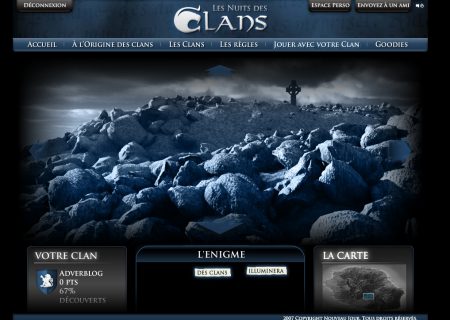
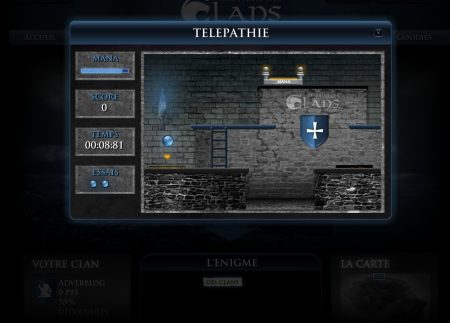
It's time for an new episode of Les Nuits Des Clans, a mysterious adventure game launched in France by Nouveau Jour (this is the post about last year's edition).

clans02.jpg

Tout en francais bien sur, but it's definitely worth giving it a try even if you don't speak the language... You find yourself on an island and you have to move around to play small (but challenging) advergames and collect words to complete a mysterious sentence that will unlock the doors of the castle.

clans01.jpg

Once the again the brand behind this complex advergaming experience it's not revealed. Last year it was Ricard, this time we don't know yet, but the mystery is part of the game so we are in no hurry to find out.

via Adverblog