
Designing Services for Financial Inclusion
View more presentations from Jan Chipchase.
IDEO partnered with International Development Enterprises (IDE), Heifer International, ICRW, and the Bill & Melinda Gates Foundation to create a toolkit for applying Human-Centered Design to inspire new solutions to difficult challenges within communities of need.
The Toolkit is divided into four sections:
The Introduction will give an overview of HCD and help you understand how it might be used alongside other methods.
Download the Intro Guide.pdf
The Hear guide will help your design team prepare for fieldwork and understand how to collect stories that will serve as insight and inspiration. Designing meaningful and innovative solutions that serve your customers begins with gaining deep empathy for their needs, hopes and aspirations for the future. The Hear booklet will equip the team with methodologies and tips for engaging people in their own contexts to delve beneath the surface.
Download the Hear Guide
The Field Guide and Aspirations cards are a complement to the Hear guide; these are the tools your team will take with them in order to conduct research.
Download the Field Guide
Download the Aspirations Cards
The Create guide will help your team work together in a workshop format to translate what you heard from people into frameworks, opportunities, solutions, and prototypes. During this phase, you will move from concrete to more abstract thinking in identifying themes and opportunities and back to the concrete with solutions and prototypes.
Download the Create Guide
The Deliver guide will help catapult the top ideas you have created toward implementation. The realization of solution includes rapid revenue and cost modeling, capability assessment, and implementation panning. The activities offered in this phase are meant to complement your organization's existing implementation processes and may prompt adaptations to the way solutions are typically rolled out.
Download the Deliver Guide
Also check the article by Alissa Walker (Fast Company)
|
Microsoft just published a series of videos where they envision the future of work and life in the year 2019. From their websites, the Microsoft Office Labs:
Take a step into the future and get a glimpse into how technology may transform the way we live and work in the years ahead. Explore some of our concepts for how leading edge technologies might be used in real world settings – such as health care, manufacturing, banking and retail – over the next 5-10 years.
via The Customer Experience Labs
Here is the video that summarizes the different future visions.
It does resonate with me, and really sums up my cultural upbringing. It is quite difficult to figure out how you can capitalize on being in born in one country (france), growing up in another (Cameroon) ad living in the third (UK). This article helps me figuring out
And to summarize the qualities of the individual,
I'm going to highlight key statements that articulate the characteristics of a person who embraces liminal space,
- Cross cultural skills such as flexibility, tolerance and strong observation skills
- As cultures and communities come increasingly into contact, we need to know how to respect, observe and learn from cultural differences.
- We are life-long learners, and the world is our classroom
- Poised to deal with rapid change. Comfortable with ambiguity.
- The ability think quickly on our feet and can take the initiative to troubleshoot -- but we often do so in a context of understanding the currents and observing the situation first.
- Flexibility and tolerance don't always translate as strong points in business.
- Observation in particular seems to be underrated.
- Tries to figure out which way the river is flowing before jumping in. i.e. sees the big picture.
- Multi-dimensional world view
- We don't assume that our way is the best or only way.
- Greater "spiritual" perspective or Open to other value systems.
- We observe that different people's experience has created different truths in their lives -- from how to relate to self and others to how to relate to spirituality.
- Question those who promote a belief that there is only ONE way to nourish a spiritual life.
- Rather than be threatened by different belief systems, relish the beauty in the diversity, taking something from everything.
A new age in innovation. Great article on consumer experience via Business Week
Despite the press attention lavished on companies such as Apple and Google, modern business is not all about Web 2.0, cutting-edge consumer tech. The latest voices reminding us of this—and that innovation is a topic with a broad scope—are those of authors and University of Michigan professors C.K. Prahalad and M.S. Krishnan.
The pair's book, The New Age of Innovation: Driving Co-Created Value Through Global Networks (McGraw Hill Books, which, like BusinessWeek, is a unit of The McGraw Hill Companies), revolves around two ideas, laid out on the first page of the first chapter. N=1 states that "value is based on unique, personalized experiences of consumers." That is, even companies serving 100 million consumers need to focus on individuals. R=G, meanwhile, argues that since no company can hope to satisfy the varied expectations of so many consumers, it must diversify how it operates. "All firms will access resources from a wide variety of other big and small firms—a global ecosystem," write Prahalad and Krishnan. In other words, companies' internal focus should be on gaining access to resources, not necessarily owning them.
The next 250 or so pages attempt to hammer home the details of this shift from impersonal to customized, vertical to horizontal, with a wealth of examples from an array of industries. In fact, one of the book's strengths is that while it names companies that seem to have seen success with at least one of the two ideas—Apple (AAPL), Facebook, Google (GOOG), and MySpace (NWS)—it also includes examples of more established companies across diverse industries that make the headlines less frequently.
UPS (UPS), for instance, has evolved from requiring customers to drop off parcels at a central collection point to picking up packages from clients at specified times. "This," write Prahalad and Krishnan, demonstrates "a significant transformation from a business process focus on the firm to a business process focus on each unique customer experience." In other words, no company can afford to think its business can plod on as usual. The ability to rethink a firm's fundamentals and implement appropriate changes will provide the driver of success within the N=1, R=G world.
Executives at Madras Cements, a division of India's Ramco Group, decided against deploying sophisticated—and expensive—GPS technology to track the movement of its trucks and goods. Instead, drivers were issued $30 cell phones and instructed to communicate their whereabouts via SMS text messages. The company designed an infrastructure that could process these raw data and give regular, timely insights into driver performance, helping executives identify areas of improvement for both individuals and the company at large. To date, the simple, innovative solution has led to recurring annual savings of more than $4 million.
Some of the themes touched on in the book will be familiar to fans of Prahalad, widely admired as a management expert and for previous books including the popular title The Fortune at the Bottom of the Pyramid (Wharton School Publishing, 2006). In fact, he introduced the co-creation theme in The Future of Competition: Co-Creating Unique Value with Customers (Harvard Business Press, 2004), and some of the same examples are wheeled out again here. But Prahalad and Krishnan clearly believe there are still lessons to be learned, even arguing that no company to date has mastered both N=1 and R=G.
They also include examples of failures and mistakes. In one powerful example that is undercut by the company in question oddly not being named (an anomaly), the authors discuss the example of a "major auto supplier" in the U.S shifting the sourcing of various parts to China. Unexpectedly, what seemed like a clear-cut business decision had a negative impact on many levels: The logistics of air-freighting parts from China wiped out any cost benefits, while the resulting lack of flexibility and longer lead times meant that the company's internal design process also had to be entirely rethought. The example provides a salient reminder of the importance of stepping back and thinking about the big picture, to consider the existence of less codified processes and systems, and to identify and preempt the potential consequences of any decision.
Sometimes The New Age of Innovation veers into the academic speak and formulaic structures so beloved of college professors, and there's a fair amount of management jargon that can be grating at times. But, in the main, this is a fairly breezy and informal read that provides a timely snapshot of a rapidly transforming business landscape. As the authors make clear, this transformation is neither optional nor reversible. This book provides a valuable primer for those wishing to stay on for the ride.
Helen Walters is the editor for BusinessWeek.com's Innovation and Design Channel .
New technologies in emerging markets is one of my favourite subject, so I am delighted by 'Putting People First' new EMweekly. A weekly dedicated to innovation, technology and emerging markets. Check it out.
 | Putting People First announces the launch of EMweekly, a compilation on Emerging Markets starting with this week’s issue on the theme of the booming Indian mobile industry. Compiled by Niti Bhan and David Tait (of the Emerging Futures Lab), EMweekly will focus on a wide ranging selection of news, links and articles as well as analysis and indepth stories from the developing world. You can also receive the EMweekly via rss or email.
Recently Experientia extended its services with qualitative user research and experience design capabilities in emerging consumer markets in developing nations such as in Sub Saharan Africa, South and South East Asia etc. This new offering is founded upon a recent structural collaboration between Experientia and three emerging market specialists — Niti Bhan (based in Singapore), Claude Martin (based in France), and David Tait (based in South Africa) — and an extensive research project in Africa we just completed for a major technology company. |
It is known simply as the X-room.

William Sullivan, managing director of the Courtyard by Marriott in Newark, Del., in a test guest room.
Set up last November at the Courtyard by Marriott in partnership with theUniversity of Delaware in Newark, it is a test guest room. It is equipped with everything from waterproof mattresses to the experimental technology of wireless electricity (no plugs) to a specially designed Nintendo Wii game console for travelers. There is also a digital door display that lets guests see who is in the corridor.
Nor is Marriott the only chain with what the lodging industry calls test rooms or room labs. From a hotelier’s perspective, a test room helps demonstrate what is working and what is not, before huge amounts of money are spent on the latest technology or new light bulbs are acquired.
“In the last five years there’s been more research on what the consumer wants than at any time during my 40 years in the industry,” said Joseph McInerney, chief executive and president of the American Hotel and Lodging Association.
Mike Jannini, executive vice president for brand management at Marriott, agreed that research had gained much more prominence in the business. Hotels, he said, are moving away from segmenting travelers by price point and are instead grouping people by attitude and lifestyle.
Marriott is already introducing some of the concepts in its hotels. William Sullivan, managing director of the hotel in Newark, Del., that houses the X-room, says the company has made some interesting findings: “Everyone is interested in the Nintendo Wii. All hotels see that has potential.” A waterproof mattress is also being tried out across a pilot group of hotels while a Marriott in Las Vegas is testing the digital door display.
The X-room was adapted from an exhibit at the Hospitality Financial and Technology Professionals trade show. Each year, the group solicits state-of the-art products for the exhibit, called Guestroom 2010, which are then demonstrated at a convention in June. Last year’s exhibit included a digital control panel that would allow travelers to use a single device to change the music, lighting, heat levels and hanging artworks depending on their moods.
Westin Hotels and Resorts opened its first test room, known as the Lab, in January 2007. In Room 1627 at the Westin Chicago River North, the test room is open to travelers who have crossed two time zones.
According to Sue Brush, senior vice president of Westin, 52 percent of guests said they felt unwell on arrival. Using that information, the company incorporated multiple calming elements like a tea menu and blackout curtains into the test room. Among the new products in the room are an oscillating fan that enables guests to direct their own airflow and even out noise, and Sleep TV, a meditation show that deactivates on completion. Ms. Brush said the company learned from the test room that guests did not like the sound machine with bird and rain noises because it was too fake.
Alison Kal, vice president for marketing at the Hyatt Corporation, said last year’s introduction of a new brand, Hyatt Place, resulted from an effort involving more research than any other concept in the company’s history. Not only did the company build a test room, it also built a test hotel in Scottsdale, Ariz.
Hyatt Place rooms are equipped with flat-panel HDTV sets and a “plug panel,” which recognizes different electronic devices and allows computer presentations to be displayed on the television screen. “People wanted a place to sit that wasn’t the bed with a surface they could wipe down,” Ms. Kal said. “We have a sectional sofa and a leather top on the ottoman. Women drove the feedback, but we executed gender neutral.”
Two boutique hotel companies, the James Hotel Group and Kimpton Hotels, have their test rooms off site. James Hotel has two guest rooms in a warehouse in Long Island City, Queens. Major clients, individual customers and staff members give their opinions on everything from linens to seating.
“If you go back to the old chains, they had prototype rooms, and before design became important it was a cookie-cutter room,” said Brad Wilson, the executive vice president of the Denihan Hospitality Group, which recently acquired James Hotel. “What’s in it today is the opposite. We use the prototype as a research lab, as a way to break away from the mold.”
Customers told James Hotel executives to make their desk space bigger, so it could accommodate food and a laptop.
The Kimpton Hotels and Restaurant Group uses the general managers’ evening wine hours to supplement research on what guests want. Niki Leondakis, Kimpton’s chief operating officer, said compact fluorescent light bulbs initially did not emit enough light and had a tendency to flicker, a problem the company worked to fix.
Mr. Sullivan of Marriott noted that too much technology can be a problem and that after 12 hours on the road, few guests wanted to read manuals. “We’ve noticed as we put in technology, we’re sitting there with 10 remote controls. We need to address that. How do you simplify that process? Every one of them takes a battery.”
Mr. McInerney recently tested the X-room, but found a few problems. While praising the “bells and whistles,” he said he could not figure out the alarm clock or how to turn on the television. “All I wanted to do was watch CNN,” he said.
via NY Times
The Economist newspaper has published a special report on mobility, wondering what the social effects will be. Sources are some of the top people in the field (many of whom are frequently written about on this blog). Our nomadic future [leader article]“Prepare to see less of your office, more of your family—and still perhaps be unhappy” or “nomadism promises the heaven of new freedom, but it also threatens the hell of constant surveillance by the tribe”. Nomads at lastWireless communication is changing the way people work, live, love and relate to places—and each other, says Andreas Kluth. Labour movementThe joys and drawbacks of being able to work from anywhere. The new oasesNomadism changes buildings, cities and traffic. Family tiesKith and kin get closer, with consequences for strangers. Location, location, locationIt matters. A world of witnessesWhen everybody becomes a nomadic monitor. Homo mobilisAs language goes, so does thought. |

SELLING TO THE OTHER THREE BILLION A cellphone shop in Accra, Ghana, which carries and repairs a variety of handsets.
If you need to reach Jan Chipchase, the best, and sometimes only, way to get him is on his cellphone. The first time I spoke to him last fall, he was at home in his apartment in Tokyo. The next time, he was in Accra, the capital of Ghana, in West Africa. Several weeks after that, he was in Uzbekistan, by way of Tajikistan and China, and in short order he and his phone visited Helsinki, London and Los Angeles. If you decide not to call Jan Chipchase but rather to send e-mail, the odds are fairly good that you’ll get an “out of office” reply redirecting you back to his cellphone, with a notation about his current time zone — “GMT +9” or “GMT -8” — so that when you do call, you may do so at a courteous hour.
Chipchase is 38, a rangy native of Britain whose broad forehead and high-slung brows combine to give him the air of someone who is quick to be amazed, which in his line of work is something of an asset. For the last seven years, he has worked for the Finnish cellphone company Nokia as a “human-behavior researcher.” He’s also sometimes referred to as a “user anthropologist.” To an outsider, the job can seem decidedly oblique. His mission, broadly defined, is to peer into the lives of other people, accumulating as much knowledge as possible about human behavior so that he can feed helpful bits of information back to the company — to the squads of designers and technologists and marketing people who may never have set foot in a Vietnamese barbershop but who would appreciate it greatly if that barber someday were to buy a Nokia.
What amazes Chipchase is not the standard stuff that amazes big multinational corporations looking to turn an ever-bigger profit. Pretty much wherever he goes, he lugs a big-bodied digital Nikon camera with a couple of soup-can-size lenses so that he can take pictures of things that might be even remotely instructive back in Finland or at any of Nokia’s nine design studios around the world. Almost always, some explanation is necessary. A Mississippi bowling alley, he will say, is a social hub, a place rife with nuggets of information about how people communicate. A photograph of the contents of a woman’s handbag is more than that; it’s a window on her identity, what she considers essential, the weight she is willing to bear. The prostitute ads in the Brazilian phone booth? Those are just names, probably fake names, coupled with real cellphone numbers — lending to Chipchase’s theory that in an increasingly transitory world, the cellphone is becoming the one fixed piece of our identity.
Last summer, Chipchase sat through a monsoon-season downpour inside the one-room home of a shoe salesman and his family, who live in the sprawling Dharavi slum of Mumbai. Using an interpreter who spoke Tamil, he quizzed them about the food they ate, the money they had, where they got their water and their power and whom they kept in touch with and why. He was particularly interested in the fact that the family owned a cellphone, purchased several months earlier so that the father, who made the equivalent of $88 a month, could run errands more efficiently for his boss at the shoe shop. The father also occasionally called his wife, ringing her at a pay phone that sat 15 yards from their house. Chipchase noted that not only did the father carry his phone inside a plastic bag to keep it safe in the pummeling seasonal rains but that they also had to hang their belongings on the wall in part because of a lack of floor space and to protect them from the monsoon water and raw sewage that sometimes got tracked inside. He took some 800 photographs of the salesman and his family over about eight hours and later, back at his hotel, dumped them all onto a hard drive for use back inside the corporate mother ship. Maybe the family’s next cellphone, he mused, should have some sort of hook as an accessory so it, like everything else in the home, could be suspended above the floor.
This sort of on-the-ground intelligence-gathering is central to what’s known as human-centered design, a business-world niche that has become especially important to ultracompetitive high-tech companies trying to figure out how to write software, design laptops or build cellphones that people find useful and unintimidating and will thus spend money on. Several companies, including Intel, Motorola and Microsoft, employ trained anthropologists to study potential customers, while Nokia’s researchers, including Chipchase, more often have degrees in design. Rather than sending someone like Chipchase to Vietnam or India as an emissary for the company — loaded with products and pitch lines, as a marketer might be — the idea is to reverse it, to have Chipchase, a patently good listener, act as an emissary for people like the barber or the shoe-shop owner’s wife, enlightening the company through written reports and PowerPoint presentations on how they live and what they’re likely to need from a cellphone, allowing that to inform its design.
The premise of the work is simple — get to know your potential customers as well as possible before you make a product for them. But when those customers live, say, in a mud hut in Zambia or in a tin-roofed hutong dwelling in China, when you are trying — as Nokia and just about every one of its competitors is — to design a cellphone that will sell to essentially the only people left on earth who don’t yet have one, which is to say people who are illiterate, making $4 per day or less and have no easy access to electricity, the challenges are considerable.
One morning last fall, I arranged to meet Chipchase in a neighborhood in Accra where he and a few other Nokia people were doing research. At his suggestion, I took a taxi to the general area and then called him on his cellphone. This part of the city, called Nima, was a jumble of narrow alleyways hemmed in by a few major thoroughfares and anchored by a teeming marketplace. The homes in Nima were small, low-roofed and usually one or two rooms made from concrete or crumbling mud bricks, often set back behind a homegrown business — someone’s peanut stand or a shack selling dust-coated secondhand stereos and television sets. The streets around the market were swollen with a slow-moving river of people. On their heads, Ghanaian women toted pyramids of pomegranates, bagged loaves of fresh bread, baskets of live chickens. Trucks belched diesel exhaust; men pushed carts full of sugar cane and fat, purplish bulbs of garlic.
From an unseen distance, Chipchase used his phone to pilot me through the unfamiliar chaos, allowing us to have what he calls a “just in time” moment. “Just in time” is a manufacturing concept that was popularized by the Japanese carmaker Toyota when, beginning in the late 1930s, it radically revamped its production system, virtually eliminating warehouses stocked with big loads of car parts and instead encouraging its assembly plants to order parts directly from the factory only as they were needed. The process became less centralized, more incremental. Car parts were manufactured swiftly and in small batches, which helped to cut waste, improve efficiency and more easily correct manufacturing defects. As Toyota became, in essence, lighter on its feet, the company’s productivity rose, and so did its profits.
There are a growing number of economists who maintain that cellphones can restructure developing countries in a similar way. Cellphones, after all, have an economizing effect. My “just in time” meeting with Chipchase required little in the way of advance planning and was more efficient than the oft-imperfect practice of designating a specific time and a place to rendezvous. He didn’t have to leave his work until he knew I was in the vicinity. Knowing that he wasn’t waiting for me, I didn’t fret about the extra 15 minutes my taxi driver sat blaring his horn in Accra’s unpredictable traffic. And now, on foot, if I moved in the wrong direction, it could be quickly corrected. Using mobile phones, we were able to coordinate incrementally. “Do you see the footbridge?” Chipchase was saying over the phone. “No? O.K., do you see the giant green sign that says ‘Believe in God’? Yes? I’m down to the left of that.”
To someone who has spent years using a mobile phone, these moments are common enough to feel banal, but for people living in a shantytown like Nima — and by extension in similar places across Africa and beyond — the possibilities afforded by a proliferation of cellphones are potentially revolutionary. Today, there are more than 3.3 billion mobile-phone subscriptions worldwide, which means that there are at least three billion people who don’t own cellphones, the bulk of them to be found in Africa and Asia. Even the smallest improvements in efficiency, amplified across those additional three billion people, could reshape the global economy in ways that we are just beginning to understand. This is part of what Chipchase was eager to show me, if only I could spot him. “I’m by the hair-salon stall,” he was saying into his phone. “Next to that goat. Do you see it? See me? Ah, yes,” he said brightly, “there you are.” And then, face to face and sweating in the climbing equatorial sun, we hung up.
To get a sense of how rapidly cellphones are penetrating the global marketplace, you need only to look at the sales figures. According to statistics from the market database Wireless Intelligence, it took about 20 years for the first billion mobile phones to sell worldwide. The second billion sold in four years, and the third billion sold in two. Eighty percent of the world’s population now lives within range of a cellular network, which is double the level in 2000. And figures from the International Telecommunications Union show that by the end of 2006, 68 percent of the world’s mobile subscriptions were in developing countries. As more and more countries abandon government-run telecom systems, offering cellular network licenses to the highest-bidding private investors and without the burden of navigating pre-established bureaucratic chains, new towers are going up at a furious pace. Unlike fixed-line phone networks, which are expensive to build and maintain and require customers to have both a permanent address and the ability to pay a monthly bill, or personal computers, which are not just costly but demand literacy as well, the cellphone is more egalitarian, at least to a point.
“You don’t even need to own a cellphone to benefit from one,” says Paul Polak, author of “Out of Poverty: What Works When Traditional Approaches Fail” and former president of International Development Enterprises, a nonprofit company specializing in training and technology for small-plot farmers in developing countries. Part of I.D.E.’s work included setting up farm cooperatives in Nepal, where farmers would bring their vegetables to a local person with a mobile phone, who then acted as a commissioned sales agent, using the phone to check market prices and arranging for the most profitable sale. “People making a dollar a day can’t afford a cellphone, but if they start making more profit in their farming, you can bet they’ll buy a phone as a next step,” Polak says.
Last year, the World Resources Institute, a Washington-based environmental research group, published a report with the International Finance Corporation entitled “The Next Four Billion,” an economic study that looked at, among other things, how poor people living in developing countries spent their money. One of the most remarkable findings was that even very poor families invested a significant amount of money in the I.C.T. category — information-communication technology, which, according to Al Hammond, the study’s principal author, can include money spent on computers or land-line phones, but in this segment of the population that’s almost never the case. What they’re buying, he says, are cellphones and airtime, usually in the form of prepaid cards. Even more telling is the finding that as a family’s income grows — from $1 per day to $4, for example — their spending on I.C.T. increases faster than spending in any other category, including health, education and housing. “It’s really quite striking,” Hammond says. “What people are voting for with their pocketbooks, as soon as they have more money and even before their basic needs are met, is telecommunications.”
There are clear reasons for this, but understanding them requires forgetting for a moment about your own love-hate relationship with your cellphone, or iPhone, or BlackBerry. Something that’s mostly a convenience booster for those of us with a full complement of technology at our disposal — land-lines, Internet connections, TVs, cars — can be a life-saver to someone with fewer ways to access information. A “just in time” moment afforded by a cellphone looks a lot different to a mother in Uganda who needs to carry a child with malaria three hours to visit the nearest doctor but who would like to know first whether that doctor is even in town. It looks different, too, to the rural Ugandan doctor who, faced with an emergency, is able to request information via text message from a hospital in Kampala.
Jan Chipchase and his user-research colleagues at Nokia can rattle off example upon example of the cellphone’s ability to increase people’s productivity and well-being, mostly because of the simple fact that they can be reached. There’s the live-in housekeeper in China who was more or less an indentured servant until she got a cellphone so that new customers could call and book her services. Or the porter who spent his days hanging around outside of department stores and construction sites hoping to be hired to carry other people’s loads but now, with a cellphone, can go only where the jobs are. Having a call-back number, Chipchase likes to say, is having a fixed identity point, which, inside of populations that are constantly on the move — displaced by war, floods, drought or faltering economies — can be immensely valuable both as a means of keeping in touch with home communities and as a business tool. Over several years, his research team has spoken to rickshaw drivers, prostitutes, shopkeepers, day laborers and farmers, and all of them say more or less the same thing: their income gets a big boost when they have access to a cellphone.
It may sound like corporate jingoism, but this sort of economic promise has also caught the eye of development specialists and business scholars around the world. Robert Jensen, an economics professor at Harvard University, tracked fishermen off the coast of Kerala in southern India, finding that when they invested in cellphones and started using them to call around to prospective buyers before they’d even got their catch to shore, their profits went up by an average of 8 percent while consumer prices in the local marketplace went down by 4 percent. A 2005 London Business School study extrapolated the effect even further, concluding that for every additional 10 mobile phones per 100 people, a country’s G.D.P. rises 0.5 percent.
Text messaging, or S.M.S. (short message service), turns out to be a particularly cost-effective way to connect with otherwise unreachable people privately and across great distances. Public health workers in South Africa now send text messages to tuberculosis patients with reminders to take their medication. In Kenya, people can use S.M.S. to ask anonymous questions about culturally taboo subjects like AIDS, breast cancer and sexually transmitted diseases, receiving prompt answers from health experts for no charge.
Some of the mobile phone’s biggest boosters are those who believe that pumping international aid money into poor countries is less effective than encouraging economic growth through commerce, also called “inclusive capitalism.” A cellphone in the hands of an Indian fisherman who uses it to grow his business — which presumably gives him more resources to feed, clothe, educate and safeguard his family — represents a textbook case of bottom-up economic development, a way of empowering individuals by encouraging entrepreneurship as opposed to more traditional top-down approaches in which aid money must filter through a bureaucratic chain before reaching its beneficiaries, who by virtue of the process are rendered passive recipients.
For this reason, the cellphone has become a darling of the microfinance movement. After Muhammad Yunus, the Nobel-winning founder of Grameen Bank, began making microloans to women in poor countries so that they could buy revenue-producing assets like cows and goats, he was approached by a Bangladeshi expat living in the U.S. named Iqbal Quadir. Quadir posed a simple question to Yunus — If a woman can invest in a cow, why can’t she invest in a phone? — that led to the 1996 creation of Grameen Phone Ltd. and has since started the careers of more than 250,000 “phone ladies” in Bangladesh, which is considered one of the world’s poorest countries. Women use microcredit to buy specially designed cellphone kits costing about $150, each equipped with a long-lasting battery. They then set up shop as their village phone operator, charging a small commission for people to make and receive calls.
The endeavor has not only revolutionized communications in Bangladesh but also has proved to be wildly profitable: Grameen Phone is now Bangladesh’s largest telecom provider, with annual revenues of about $1 billion. Similar village-phone programs have sprung up in Rwanda, Uganda, Cameroon and Indonesia, among other places. “Poor countries are poor because they are wasting their resources,” says Quadir, who is now the director of the Legatum Center for Development and Entrepreneurship at M.I.T. “One resource is time, another is opportunity. Let’s say you can walk over to five people who live in your immediate vicinity, that’s one thing. But if you’re connected to one million people, your possibilities are endless.”
During a 2006 field study in Uganda, Chipchase and his colleagues stumbled upon an innovative use of the shared village phone, a practice called sente. Ugandans are using prepaid airtime as a way of transferring money from place to place, something that’s especially important to those who do not use banks. Someone working in Kampala, for instance, who wishes to send the equivalent of $5 back to his mother in a village will buy a $5 prepaid airtime card, but rather than entering the code into his own phone, he will call the village phone operator (“phone ladies” often run their businesses from small kiosks) and read the code to her. She then uses the airtime for her phone and completes the transaction by giving the man’s mother the money, minus a small commission. “It’s a rather ingenious practice,” Chipchase says, “an example of grass-roots innovation, in which people create new uses for technology based on need.”
It’s also the precursor to a potentially widespread formalized system of mobile banking. Already companies like Wizzit, in South Africa, and GCash, in the Philippines, have started programs that allow customers to use their phones to store cash credits transferred from another phone or purchased through a post office, phone-kiosk operator or other licensed operator. With their phones, they can then make purchases and payments or withdraw cash as needed. Hammond of the World Resources Institute predicts that mobile banking will bring huge numbers of previously excluded people into the formal economy quickly, simply because the latent demand for such services is so great, especially among the rural poor. This bodes well for cellphone companies, he says, since owning a phone will suddenly have more value than sharing a village phone. “If you’re in Hanoi after midnight,” Hammond says, “the streets are absolutely clogged with motorbikes piled with produce. They give their produce to the guy who runs a vegetable stall, and they go home. How do they get paid? They get paid the next time they come to town, which could be a month or two later. You have to hope you can find the stall guy again and that he remembers what he sold. But what if you could get paid the next day on your mobile phone? Would you care what that mobile costs? I don’t think so.”
In February of last year, when Vodafone rolled out its M-Pesa mobile-banking program in Kenya, it aimed to add 200,000 new customers in the first year but got them within a month. One year later, M-Pesa has 1.6 million subscribers, and Vodafone is now set to open mobile-banking enterprises in a number of other countries, including Tanzania and India. “Look, microfinance is great; Yunus deserves his sainthood,” Hammond says. “But after 30 years, there are only 90 million microfinance customers. I’m predicting that mobile-phone banking will add a billion banking customers to the system in five years. That’s how big it is.”
When he is not doing his field work, Jan Chipchase goes to a lot of design conferences, where he gives talks with titles like “Connecting the Unconnected.” He also writes a popular blog called Future Perfect, on which he posts photographs of some of the things that amaze him along with a little bit of explanatory text. “Pushing technologies on society without thinking through their consequences is at least naïve, at worst dangerous . . . and IMHO the people that do it are just boring,” he writes on his blog’s description page. “Future Perfect is a pause for reflection in our planet’s seemingly headlong rush to churn out more, faster, smaller and cheaper.”
Clearly, though, Chipchase’s work puts him smack in the middle of this rush, and no company churns out phones like Nokia, which manufactures 1.3 million products daily. Forty percent of the mobile phones sold last year were made by Nokia, and the company’s $8.4 billion profit in 2007 reflects as much. Chipchase seems distinctly uncomfortable talking about his part as a corporate rainmaker, preferring to see himself as a mostly dispassionate ethnographer, albeit one with Nokia stock options. The only time I saw him get even slightly prickly — or indeed behave like anything but a mild-mannered guy who is wholly absorbed by the small, arcane things that serve as clues to bigger patterns of communication — was when I happened to muse that maybe there were still places in the world where technology might not be so vital.
We were sitting under a slow-revolving ceiling fan in a small restaurant in Accra, eating bowls of piquant Ghanaian peanut-and-chicken stew. Chipchase told a story about meeting some monk disciples at a temple in Ulan Bator, when he vacationed in Mongolia a few Decembers ago. (Most of Chipchase’s vacation stories, it turns out, take place in less-developed countries, often in forbidding weather and frequently relating back to cellphone use.) Despite their red robes and shaved heads and the fact they were spending their days in a giant monastery at the top of a windy hill where they were meant to be in dialogue with God, some of the 15 monk disciples had cellphones — Nokia cellphones — and most were fancier models than the one Chipchase was carrying. One of the disciples asked to look at Chipchase’s phone. “So he’s got my phone and his phone,” Chipchase told me. “And as we’re talking, he’s switching on the Bluetooth. And he then data-mines my phone for all its content, all my photographs and so on, which is absolutely fine, but it’s kind of a scene where you think, I’m here, I’m so away from everything and yet they’re so technically literate. . . . ”
This is when I voiced a careless thought about whether there might be something negative about the lightning spread of technology, whether its convenience was somehow supplanting traditional values or practices. Chipchase raised his eyebrows and laid down his spoon. He sighed, making it clear that responding to me was going to require patience. “People can think, yeah, monks with cellphones, and tsk, tsk, and what is the world coming to?” he said. “But if you wanted to take phones away from anybody in this world who has them, they’d probably say: ‘You’re going to have to fight me for it. Are you going to take my sewer and water away too?’ And maybe you can’t put communication on the same level as running water, but some people would. And I think in some contexts, it’s quite viable as a fundamental right.” He paused a beat to let this sink in, then added, with just a touch of edge, “People once believed that people in other cultures might not benefit from having books either.”
For the last year, Chipchase has been working on a project he calls Future Urban, the goal of which is to explore what the cities of tomorrow will be like. Which is why one afternoon in Ghana he provided me with minute-to-minute cellphone instructions (“Do you see the sewing stall? O.K., now look to the right”) for finding him at the outskirts of Buduburam, a densely populated refugee settlement about an hour’s drive west of Accra. For the previous 11 days, Chipchase, two of his female colleagues from Tokyo — Indri Tulusan and Younghee Jung — and a small group of hired Ghanaians had been running what they called an “open design studio” in the heart of Buduburam, which is home to approximately 40,000 people, most of whom had fled from the civil wars in neighboring Liberia, Sierra Leone and Ivory Coast.
Nokia’s temporary design studio sat in a rented two-room concrete hut at the intersection of two busy dirt lanes, across from a woman selling chunks of watermelon and peeled lemons and next to a large water tank labeled “Church of God.” There was a sheet of fabric strung up in front, with neat painted lettering that read: “Your Dream Phone. Share it with the world.” It went on to describe how the community was invited to come share ideas and drawings for the ideal mobile phone. Prizes were offered. So far, 140 people had shown up to sketch their dream phone.
“For the first time, there are more people living in urban centers than in rural settings,” Chipchase explained as we sat in the shade outside the studio. “And in the next years, millions more will move to these places.” At current rates of migration, the United Nations Human Settlements Program has projected that one-quarter of the earth’s population will live in so-called slums by the year 2020. Slums, by sheer virtue of the numbers, are going to start mattering more and more, Chipchase postulated. In the name of preparing Nokia for this shift, he, Jung and Tulusan, along with a small group of others, spent several weeks in various shantytowns — in Mumbai, in Rio, in western China and now here in Ghana.
People in the mobile-handset business talk about adding customers not by the millions but by the billions, if only they could get the details right. How do you make a phone that can be repaired by a streetside repairman who may not have access to new parts? How do you build a phone that won’t die a quick death in a monsoon or by falling off the back of a motorbike on a dusty road? Or a phone that picks up distant signals in a rural place, holds a charge off a car battery longer or that can double as a flashlight during power cuts? Influenced by Chipchase’s study on the practice of sharing cellphones inside of families or neighborhoods, Nokia has started producing phones with multiple address books for as many as seven users per phone. To enhance the phone’s usefulness to illiterate customers, the company has designed software that cues users with icons in addition to words. The biggest question remains one of price: Nokia’s entry-level phones run about $45; Vodafone offers models that are closer to $25; and in a move that generated headlines around the world, the Indian manufacturer Spice Limited recently announced plans to sell a $20 “people’s phone.”
Even as sales continue to grow, it is yet to be seen whether the mobile phone will play a significant, sustained role in alleviating poverty in the developing world. In Africa, it’s still only a relatively small percentage of the population that owns cellphones. Network towers are not particularly cost-effective in remote areas, where power is supplied by diesel fuel. “I don’t see cellphones as a magic bullet per se, though they’re obviously very helpful,” says Ken Banks, founder of kiwanja.net, a nonprofit entity that provides free text-messaging software and information-technology support to grass-roots enterprises, mostly in Africa. “Many people in the developing world don’t yet have a phone — not because they don’t want one but because there are barriers. And the only way companies are going to sell phones is to understand what those barriers are.” He cites access to reliable electricity as a major barrier, noting that Motorola now provides free solar-powered charging kiosks to female entrepreneurs in Uganda, who use them to sell airtime. The company is also testing wind- and solar-powered base stations in Namibia, which could bring down the cost of connecting remote areas to cellular networks. “Originally mobile-phone companies weren’t interested in power because it’s not their business,” Banks says. “But if a few hundred million people could buy their phones once they had it, they’re suddenly interested in power.”
Many of the people in Buduburam who came to sketch their ideas for a perfect phone at the Nokia studio did not actually own one. The community’s power grid had been down for the last month, so those who did have one had been paying to have their phones charged at a local shop with a diesel-run generator. But when I paged through the fat three-ring binders where the Nokia team was storing those sketches, it was evident that the future, or at least some vision of it, had already arrived. Some of the drawings were basic pencil sketches; others were strikingly elaborate, with arrows pointing to different dream features, which were really just a way of pointing — I realized then — to the dreams themselves.
Jung and Tulusan said they’d found this everywhere, the phone representing what people are aspiring to. “It’s an easy way to see what’s important to them, what their challenges are,” Jung said. One Liberian refugee wanted to outfit a phone with a land-mine detector so that he could more safely return to his home village. In the Dharavi slum of Mumbai, people sketched phones that could forecast the weather since they had no access to TV or radio. Muslims wanted G.P.S. devices to orient their prayers toward Mecca. Someone else drew a phone shaped like a water bottle, explaining that it could store precious drinking water and also float on the monsoon waters. In Jacarèzinho, a bustling favela in Rio, one designer drew a phone with an air-quality monitor. Several women sketched phones that would monitor cheating boyfriends and husbands. Another designed a “peace button” that would halt gunfire in the neighborhood with a single touch.
Interestingly, the recent post-election violence in Kenya provided a remarkable case study for the cellphone as an instrument of both war and peace. After the government imposed a media blackout in late December last year, Kenyans sought news and information via S.M.S. messages on their phones and used them to track down friends and family who’d fled their homes. Many also reported receiving unsolicited text messages to take up arms. The government responded with an admonition, sent, of course, via S.M.S.: “The Ministry of Internal Security urges you to please desist from sending or forwarding any S.M.S. that may cause public unrest. This may lead to your prosecution.”
As a joke, Chipchase sometimes pulls out his cellphone and pretends to shave his face with it, using a buzzing ring tone for comic effect. But there’s a deeper truth embedded here, not just for people in places like Kenya or Buduburam but for all of us. As cellphone technology grows increasingly sophisticated, it has cannibalized — for better or worse — the technologies that have come before it. Carrying a full-featured cellphone lessens your needs for other things, including a watch, an alarm clock, a camera, video camera, home stereo, television, computer or, for that matter, a newspaper. With the advent of mobile banking, cellphones have begun to replace wallets as well. That a phone might someday offer a nice close shave suddenly seems not so ridiculous after all.
One morning I followed Chipchase as he waded deep into the Nima market, a hodgepodge of vegetable stalls and phone-booth-size stores selling sundries like candles and palm oil. He was accompanied by a Ghanaian interpreter and two Nokia designers who had flown in from California to test the cultural waters for a phone that — if everything played out perfectly — could cost as little as $5. The $5 phone was still a pie-in-the-sky concept, explained Duncan Burns, one of the designers, something they were fiddling with to see if it might be possible someday probably years from now. Each time the group stopped to chat with someone, Burns pulled out several prototypes — or “physical sketches,” as he called them — for potential phones, handing them over one by one for examination.
These were elegant, futuristic-looking things, just odd enough to seem as if they’d arrived not from California but from outer space. One was long and wandlike, looking something like an aluminum version of a thick vanilla bean. Another was a slimmer rendering of an everyday phone but with no keypad and no screen, just a single unmarked button. A third did not look at all like a phone but rather like a credit card. There were a couple of small digital photos of people’s faces stuck to the front of the card, and it came with a small stylus that could be used, Burns said, to touch a face on the card, which would then dial that person’s number — a pictorial address book for someone who was illiterate. A fourth had a camera that took pictures and deposited them right into the phone’s address book.
A young man selling beans stared at each of the pretend phones uncomfortably, as if he mistrusted the devices or perhaps the small crowd of sweat-soaked foreigners suddenly leaning in close to see how he handled them.
“How would you use that?” Chipchase asked through the interpreter, using a dialect called Twi and pointing to the wand phone. The bean seller tentatively lifted it to his ear. “Where would you keep it?” The young man gestured to his neck. “On a rope?” Chipchase said. The man, still looking bewildered, nodded yes.
Moments later, we came upon an ample-bodied woman dressed in a bright gold wrapper and matching head scarf, sifting rocks and twigs out of scoopfuls of corn beneath an umbrella in a quiet corner of the market.
“Hellllloooooo,” Chipchase said, smiling broadly.
“Helllllooooo, Brudda,” she said back in English.
“We work for Nokia. You know Nokia?”
The woman said nothing, but reached down and from the folds of her wrapper produced a Nokia phone. “Not good,” she said, shaking her head disparagingly. “You call. It switches off.”
Chipchase enlisted the interpreter to explain that her problem sounded like a network problem and not a Nokia problem. Shrugging, the woman went on to inspect the prototype phones, testing their weight in her palm, pressing them against her cheek, punching buttons. She pooh-poohed the stylus phone but said she liked the one-button model if it meant she didn’t need to use a lot of numbers. “Brudda, how do you charge it?” she asked. From his bag, Burns pulled another still-conceptual design, this one a thin metal cylinder with a whirlybird antenna on top. He showed the corn seller how to rotate the cylinder in small circles, causing the antenna to swing, which, he explained, in 15 minutes or so would generate enough power to charge her phone battery.
The woman picked up the futuristic gizmo and began to swing it; the antenna whipped around and around. She let out an enthusiastic whoop. Then a friend of hers who’d been sitting in the shadow of her umbrella started to laugh. Another woman, a spice seller perched on a stool next to small mountains of turmeric and cumin heaped on canvas cloths, began to laugh also. “Very nice,” the corn seller said to Burns and Chipchase, swinging the antenna like a toy. “It’s good!” Then, after a moment, she gathered her composure and handed the charger off to her son, a heavy-lidded teenager who was lounging on a sack of corn nearby. “Doing that,” she said blithely as she returned to picking through her kernels of corn, “can be his job.”
via New York Times
© mknobil
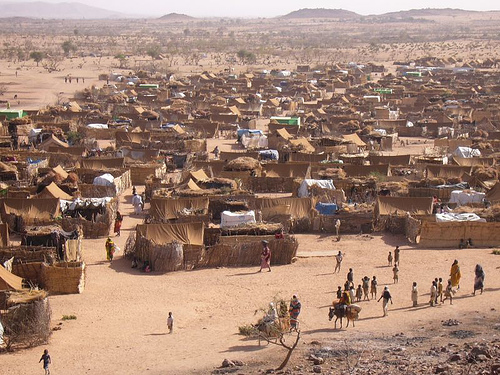
Google has joined hands with the UN High Commission for Refugees to create a new mapping system that will allow users of its Goggle Earth tool to track the movement of refuges across the planet. The Commission that estimates around 35 million people all over the world have been displaced from their homelands, recently unveiled the new multimedia system.
The interactive system can be downloaded at unhcr.org/googleearth, and allows users to see satellite images of refugee hotspots, read about the violence that drove people from their homes in those regions, and watch videos of the conflict there. Currently, users can access refugee details in Colombia, Darfur, and Iraq. By the end of 2008, the UNHCR aims to have all the world’s major conflict areas on the map.
Unfortunately, Google Earth has found its mapping application being used by terrorists, and there are concerns about the dangers of making such detailed refugee movement facts and figures available to everyone. Officials at UNHCR says they are still discussing how much of the information can be readily available to all.
Google estimates that its Google Earth program has been downloaded by around 360 million users. The program was seen as a big help during Hurricane Katrina, leading Google to offer other nonprofit organizations and agencies use of their mapping software.
via vagabondish
IF executives are going to rely on the wisdom of the masses for business help, it’s probably time the masses get a little compensation for it.
That’s the theory behind Kluster, the newest in a lineup of companies using the Web to channel the collective wisdom of strangers into meaningful business strategies. With a cash reward system for contributors and a big beginning at the TED conference last week in Monterey, Calif., Kluster hopes to attract just enough visitors with just enough business smarts to gain early momentum.
Along with members of the public, the 1,000 attendees of TED, a conference named for technology, entertainment and design that attracts leaders from many industries, used Kluster to generate ideas for a new product, then chose the most promising one and collaborated on the design. The result was “Over There,” an educational board game intended to promote cultural awareness, with questions like, “What percentage of the world’s population lives further than one mile from their nearest pure water source?”
According to Ben Kaufman, Kluster’s 21-year-old founder, there were a few parameters, including provisions that the product could not be wider or longer than eight inches and only specific materials, like single-injection plastic, could be used. Going into the process, Mr. Kaufman said he hoped the product would “be something that doesn’t just serve an uninteresting consumer need, but a humanitarian product that can be used by everyone.”
Mr. Kaufman said that would actually be a departure for him. As a founder of Mophie, a manufacturer of iPod accessories, Mr. Kaufman last year held a product design contest at the Macworld conference, with attendees submitting ideas and using a company Web site to refine designs and vote on the winner.
Out of that came the Bevy — a key chain and bottle opener built into the case for an iPod Shuffle — which Mophie sold by the thousands to retailers around the world. On the heels of that success, Mr. Kaufman in August sold Mophie for an undisclosed sum, then set out to build a business out of the process he used at Macworld.
Kluster includes a number of refinements to that process. Those who join are given 1,000 units of Kluster scrip, called “watts,” and they may earn more by telling the site more about themselves, like their area of expertise, age and income. Meanwhile, businesses are invited to post specific tasks to be addressed, like creating a new product, logo or corporate event.
Participants browsing the ideas offered by Kluster members can bet some or all of their watts on the ideas they most believe in, or post ideas of their own. Those who had winning ideas earn at least 20 percent of the bounty offered by the company that sought the idea, as well as more watts, while those who bet on the winning idea earn watts. Those who bet wrong lose what they wagered.
•
Mr. Kaufman said several well-known manufacturers would offer projects on the site after the TED contest. He would not disclose the identities of those businesses, but some, he said, would offer $50,000 or more for winning ideas, while others expect to give far less and hope that they have enough good will among their customers to spur ideas.
Kluster will make money, he said, by taking 15 percent of any rewards offered to projects and by charging fees for prominent placement of projects on the site, among other things.
Don Tapscott, the business strategy consultant and co-author of the book “Wikinomics,” said executives were quickly warming to the strategic value of “P.F.E.” ideas, or those “proudly found elsewhere.”
“Throughout the 20th century, we’ve had this view that talent is inside the company,” Mr. Tapscott said. “But with the Web, collaboration costs are dropping outside the boundaries of companies, so the world can become your talent.”
Mr. Tapscott, who credited Procter & Gamble with the P.F.E. concept, said executives can go overboard with the idea of outsourcing innovation if, in seeking such help, they expose too much of a company’s trade secrets. But so far, he knows of no business that has done so.
“They always err on the other side,” he said. “They don’t do enough.”
Among the obstacles in Kluster’s path are sites like InnoCentive and Cambrian House, which operate similarly. InnoCentive, based in Waltham, Mass., was until late last year a forum for solving science-related problems, typically for cash rewards. In September, it expanded into business, engineering and computer science, among other things. Since then it has grown by 15,000 participants, to 140,000, the company said.
Cambrian House, which is based in Calgary, Alberta, and has 64,000 participants, will also expand its Web site this year to accommodate projects across a broader range of industries. Until now, said Jasmine Antonick, a Cambrian House founder, the site has attracted mostly software and Web entrepreneurs.
Ms. Antonick expects the site to be profitable later this year, when it receives a share of payments made by businesses to several of Cambrian House’s participants, like two men who created Gwabs, an online video game that is to be distributed by an undisclosed company this summer.
•
Next month, it will introduce VenCorps, a site on which venture capitalists and other investors will review business ideas from the public and, after about 30 days, reward the best idea with $50,000 in exchange for a share of ownership.
VenCorps is a partnership between Cambrian House and Spencer Trask Collaborative Venture Partners, a division of the New York venture firm Spencer Trask. Sean Wise, a Collaborative Venture Partners founder, says he has high hopes for the site.
“No matter how good a V.C. I could be,” he said, “I could never be smarter than the wisdom of a collective community.”
Josh Bernoff, an analyst with Forrester Research, said that Kluster had “commercial potential.” “Asking communities for help with solving problems is certainly going to help businesses,” he said. “It’s just not something you can count on delivering business value yet.”
via NY Times



