Friday, May 23

A new book from the Bottom of the Pyramid guru lays out the new landscape of business, driven by consumer co-c

A new age in innovation. Great article on consumer experience via Business Week

Despite the press attention lavished on companies such as Apple and Google, modern business is not all about Web 2.0, cutting-edge consumer tech. The latest voices reminding us of this—and that innovation is a topic with a broad scope—are those of authors and University of Michigan professors C.K. Prahalad and M.S. Krishnan.

The pair's book, The New Age of Innovation: Driving Co-Created Value Through Global Networks (McGraw Hill Books, which, like BusinessWeek, is a unit of The McGraw Hill Companies), revolves around two ideas, laid out on the first page of the first chapter. N=1 states that "value is based on unique, personalized experiences of consumers." That is, even companies serving 100 million consumers need to focus on individuals. R=G, meanwhile, argues that since no company can hope to satisfy the varied expectations of so many consumers, it must diversify how it operates. "All firms will access resources from a wide variety of other big and small firms—a global ecosystem," write Prahalad and Krishnan. In other words, companies' internal focus should be on gaining access to resources, not necessarily owning them.

The next 250 or so pages attempt to hammer home the details of this shift from impersonal to customized, vertical to horizontal, with a wealth of examples from an array of industries. In fact, one of the book's strengths is that while it names companies that seem to have seen success with at least one of the two ideas—Apple (AAPL), Facebook, Google (GOOG), and MySpace (NWS)—it also includes examples of more established companies across diverse industries that make the headlines less frequently.

Examples of Success

UPS (UPS), for instance, has evolved from requiring customers to drop off parcels at a central collection point to picking up packages from clients at specified times. "This," write Prahalad and Krishnan, demonstrates "a significant transformation from a business process focus on the firm to a business process focus on each unique customer experience." In other words, no company can afford to think its business can plod on as usual. The ability to rethink a firm's fundamentals and implement appropriate changes will provide the driver of success within the N=1, R=G world.

Executives at Madras Cements, a division of India's Ramco Group, decided against deploying sophisticated—and expensive—GPS technology to track the movement of its trucks and goods. Instead, drivers were issued $30 cell phones and instructed to communicate their whereabouts via SMS text messages. The company designed an infrastructure that could process these raw data and give regular, timely insights into driver performance, helping executives identify areas of improvement for both individuals and the company at large. To date, the simple, innovative solution has led to recurring annual savings of more than $4 million.

Unforeseen Consequences

Some of the themes touched on in the book will be familiar to fans of Prahalad, widely admired as a management expert and for previous books including the popular title The Fortune at the Bottom of the Pyramid (Wharton School Publishing, 2006). In fact, he introduced the co-creation theme in The Future of Competition: Co-Creating Unique Value with Customers (Harvard Business Press, 2004), and some of the same examples are wheeled out again here. But Prahalad and Krishnan clearly believe there are still lessons to be learned, even arguing that no company to date has mastered both N=1 and R=G.

They also include examples of failures and mistakes. In one powerful example that is undercut by the company in question oddly not being named (an anomaly), the authors discuss the example of a "major auto supplier" in the U.S shifting the sourcing of various parts to China. Unexpectedly, what seemed like a clear-cut business decision had a negative impact on many levels: The logistics of air-freighting parts from China wiped out any cost benefits, while the resulting lack of flexibility and longer lead times meant that the company's internal design process also had to be entirely rethought. The example provides a salient reminder of the importance of stepping back and thinking about the big picture, to consider the existence of less codified processes and systems, and to identify and preempt the potential consequences of any decision.

Sometimes The New Age of Innovation veers into the academic speak and formulaic structures so beloved of college professors, and there's a fair amount of management jargon that can be grating at times. But, in the main, this is a fairly breezy and informal read that provides a timely snapshot of a rapidly transforming business landscape. As the authors make clear, this transformation is neither optional nor reversible. This book provides a valuable primer for those wishing to stay on for the ride.

Helen Walters is the editor for BusinessWeek.com's Innovation and Design Channel .

Thursday, May 22

Kindergarten by cercadelcielo

cercadelcielo designed this colorful kindergarten in Murcia, Spain, like an open space were the kids could run and play free. There are only three prefabricated boxes, semitransparent, that enclose more specific functions, such as kitchen and rest rooms.

via Coolboom

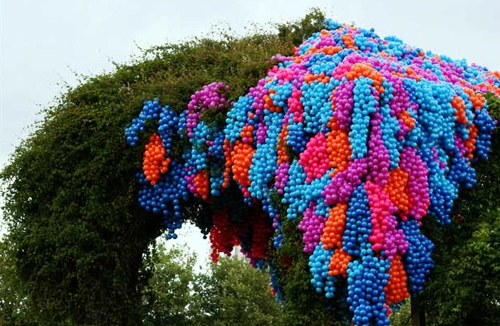
claude cormier: “pergola”

To celebrate the inaugural year of the Arts Le Havre Biennale d’Art Contemporain, Montréal-based landscape architect and urban designer Claude Cormier constructed a beautiful impressionist tribute to one of the world’s most famous painters - Le Havre’s own Claude Monet.


Meant to mirror the wisteria flowers that showed up in so many of Monet’s works, “Pergola” is made up of 90,000 plastic balls draped into the trees outside the Le Havre City Hall. I like the weird juxtaposition of the technicolour plastic balls against the organic green of the trees. I kind of want to yank them all down, create a ball pit, and throw some children in it… but this is good too.

via Shape+Colour

Via Lost At E Minor

Bjarke Ingels presents The BIG CPH Experiment

BIG Architects exhibits CPH Experiments in UK during London Festival of Architecture

On occasion of the London Festival of Architecture 2008 (www.lfa2008.org), Storefront will be opening its first temporary outpost in Europe on Exhibition Road, London. The opening party will be held on June 20 and the exhibition will remain open until July 27.

The BIG CPH Experiment, an exhibition that inaugurated at Storefront for Art and Architecture in New York in October 2007, presents a series of recent design projects and large-scale models by the Copenhagen-based architecture practice BIG/Bjarke Ingels Group. The centerpiece of the exhibition is a model of the LEGO Towers made out of 250,000 LEGO bricks. BIG’s architecture emerges out of a careful analysis of how contemporary life constantly evolves and changes. In their projects, BIG tests the effects of size and the balance of programmatic mixtures on the triple bottom line of the social, economical and ecological outcome. Like a form of programmatic alchemy, they create architecture by mixing conventional ingredients such as living, leisure, working, and shopping.

Reminds me of an article in Time Magazine where a 7 year old little girl was ashamed of his father’s career, because she thinks her dad is the only adult that is obsess with toys. Her father is a movie director (stop motion animator).

BIG Architects exhibits CPH Experiments in UK during London Festival of Architecture


via Mirage.Studio.7

Image Source: LFA

Olafur Eliasson

The Danish-Icelandic artist’s interest in the transformation of nature and technology is confirmed in this project that results from two years’ work with BMW.

When, in 2005, the German car manufacturer asked Eliasson to design an “art car”, the artist took the opportunity to go beyond the simple work of art and came up with the BMW H2R, a hydrogen- powered racing car that combines record speed with maximum sustainability. With the installation Your mobile expectations: BMW H2R project at the Pinakothek der Moderne in Munich (from May 28 to July 20), Eliasson presents the prototype of this four-wheeled gem to the public. But by substituting the outer cladding with two sheets of metal and a fragile layer of ice, he also transforms it into a broader refl ection on the effects of mobility on the environment. E.S.

via Domus

My Berry

Cute little ice-cream shop in Paris designed by Claudio COLUCCI
When summer arrives you can gorge yourself,
it's 0% fat and 100% fruit


images via myberry

City Lounge by Carlos Martinez

City Lounge is an outdoor space in the center of St. Gallen, Switzerland, that has been designed by Carlos Martinez in collaboration with Pipilotti Rist, as a result of a design competition to create a public living room.

A red carpet flows all around the buildings, recreating places to relax, places to converse, places to park, fountains, even fake cars you can climb on.

It’s an amazing project that brings life to the city.

Photos by Thomas Mayer

via coolboom

Via Judit Bellostes

Tuesday, May 20

Pantone fun: Everybody Dance Now


Everybody Dance Now
LVHRD

The party-loving, vowel-hating organization LVHRD is back with another installment of its creativity competitions Tuesday night. DNCHRD, held in a secret space in Midtown Manhattan (the location will be e-mailed or texted to ticket-buyers a few hours before the event), features six color-coordinated dance teams vying to make you think they can dance. The soundtrack comes courtesy of the British D.J./V.J. crew Eclectic Method, who remixed for the likes of Fatboy Slim and U2. And of course, it’s got an interactive video wall. To participate, come dressed in the color of your ticket, or go rainbow and join them all.


via New York Times

Wednesday, May 14

Rebranding Miami: Out Miami Vice, in Design Miami

new miami ad.jpg

What happens in Miami doesn't have to stay in Miami. In fact, if all goes well, visitors should leave there with something to take home and put on the wall -- or on the floor or in the closet. At least that's the message of the city's newest tourism campaign, which replaces bikini-clad lovelies lounging poolside at boutique hotels (not that there's anything wrong with that) with the work of local artists and designers to extol the city as not only sizzling but also "a refined destination awash in culture." In the above ad, created by agency Turkel and debuting this month in such publications as The New Yorker and Architectural Digest, a man dives into a sea of (digitally multiplied) benches created by local furniture designer Avner Zabari.

Word of the new campaign (catchphrase: "Miami: Express Yourself") made the front page of yesterday's Miami Herald, which titled the story "From Abs to Abstract."

"We've created a more sophisticated image of Miami," said Rolando Aedo, marketing director for the Greater Miami Convention and Visitors Bureau, which commissioned the new campaign. "We're shifting from style to more substance."
But not everyone is sure that slightly surreal riffs on Art Basel, Design Miami, and the city's new performing arts center will succeed in their goal of drawing more tourists. "You're not bringing down the 20- and 30-year-olds with art," said Alan Lieberman, an art collector and owner of the South Beach Group of hotels targeting young vacationers. "Art is nice, and it adds to our culture and it sells condos. But it doesn't sell hotel rooms. Sex sells." Of course, the two aren't mutually exclusive. Might we suggest a future campaign featuring the work of Marilyn Minter or Vanessa Beecroft, or perhaps some of the more staid photos of Thomas Ruff? Our mind boggles at what fun Minter could have with sand.

via Mediabistro

Tuesday, May 13

What are they stressing about

The new Justice's video Stress, directed by Romain Gravas is causing much controversy in France at the moment, even mentionned in the morning news between the saga sarko and the weather forecasting. It seems to be much more about the relationship between France and its banlieues than the clip itself.

Quite simply a cross (let's avoid the cross debate, some have mentioned the predominantly muslim communities in the french suburbs made the display of the cross unthinkable: are they thinking about this way too much,it seems so), anyway a cross between La haine and a Clockwork Orange. You can find a bunch of guys attacking lonely females, beating up cops and setting stolen cars on fire. Being generally quite aggresive. Nothing you've not seen before and certainly not as violent as smack my bitch up by Prodigy. La haine (Mathieu Kassovitz) was the first major film depicting life in the parisian suburbs and funny enough like this video was directed by the wealthy and educated son of a famous filmmaker (Costa-Gravas for Romain and Peter Kassovitz for Mathieu)
The song on Romain Gravas myspace page is a classic french tune called quand on arrive en ville from the musical starmania (massive hit in the 80s), a song about some young people hitting town on a nice evening to destroy everything (nice analogy). It is quite literraly what they do in the video. Gratuitous violence, hey want to be heard, recognized, but it probably doesn't matter that much really. What we now know is that France is far from having sorted its problems with its banlieues.
What shock the french middle class most is probably the fact that the violence is no longer confine to the poor suburds, it can come much closer, as the riots showed in 2005. This video made by one of them is just a reminder of what hides across the motorway. The people who live in those suburbs (banlieues) do not want to be associated with thugs (racailles) only because they are from the same council estates. They don't want to see the middle class spreading the stereotypes in pop music videos.

But really what is depicted is just what happened in any urbanised city accross the globe. Pointless polemic really. Well judge for yourself..............


Sunday, May 11

Swarovski Flagship Store in Tokyo by Tokujin Yoshioka


via Designlines

Design mon amour

Spring/Summer 08, the design season is really taking off and if you are in the area don't miss this conference.

via Designblast

ELIO CACCAVALE

The artist and designer Elio Caccavale was born in Naples, Italy and studied product design at the Glasgow School of Art as well as at the Royal College of Art in London. In his work he deals with socio-critical issues, which he illustrates in the form of fictive scenarios. Biotechnology is a significant element of his work. In one of his projects called “Utility Pets”, Caccavale’s central theme is the breeding of human organs in pigs bodies, as well how these “production animals” are kept and handled. One part of the concept, for instance, is a protective mask to protect the pigs - with their valuable “replacement parts” - from cigarette smoke. His complex and bizarre scenarios are not just a product of the imagination but also result from teamwork with biologists, ethnologists, and social scientists. eliocaccavale.com

Work Caccavale
DANIEL EATOCK
Daniel Eatock

Daniel Eatock studied at the London Royal College of Art and was employed at the Walker Art Center in Minneapolis, Minnesota before he founded his own studio. His work is always conceptual, whether for self-imposed projects or for assignments on behalf of clients, such as the British version of “Big Brother“ and the television station “Channel 4”. What makes Eatocks work exceptional is his ability to observe the everyday phenomena of life from an artistic point of view and transform it into a work of art. Thus he collects ambiguous pictures of water puddles, garbage bags, FedEx-trucks or scratched car bodies, painting random pictures with Pantone felt-tip pens, which were once the typical art directors’ tool. Especially striking is his dance to the sound of car alarms in everyday street scenes of our cities. Also here he stays true to his motto: “Say YES to fun & function & NO to seductive imagery & colour!” danieleatock.com

Work Eatock
MARIO LOMBARDO

Mario Lombardo has become one of Germany’s most sought-after editorial designers. Just recently, at Hamburg’s Lead Awards, he was made “Visual Leader of the Year 2008”. Moreover, from 2001 to 2006 he was the art director of the music journal “Spex”, and today he is responsible for the graphic design of the new alternative-lifestyle magazine “Liebling”. His main interest revolves around projects in music, art and culture. Thus he designed the graphic appearance of the exhibition “Vertrautes Terrain” (Familiar Territory) – Contemporary Art in/about Germany”, a range of contemporary German art presented at the Center for Art and Media Karlsruhe (22.05. – 21.09.2008). mariolombardo.com

Work Lombardo
RICHARD SWEENEY

Richard Sweeney has elevated the product designer’s typical model-building with cardboard to an art form and now develops complex structures from plain paperboard. Even though he creases, cuts, folds and glues the paper by hand, his modules look as perfect as if made by computers or robots. Richard Sweeney developed sculptures for the DKNY store in London and was Designer in Residence at the famous London Design Museum in 2007. The young designer completed his design studies at the Batley School of Art and Design and at Manchester Metropolitan University. richardsweeney.co.uk

Work Sweeney

Daniël van der Velden lives in Amsterdam, where he works as a graphic designer and author. He publishes regularly on topics such as brand design, graphic design and design research, as well as on „black metal“ music. With Vinca Kruk and Gon Zinfroni, van der Velden is a partner of Metahaven, an agency active in the field of design research. Between 1998 and 2007, he developed with designer Maureen Mooren not only innovative brand design projects but also concepts for the graphics and content of the architecture journal Archis, as well as the appearance of the Holland Festival. The pair also worked for the Stedelijk Museum Amsterdam, Droog Design, TNT, Magasin 3 Stockholm Konsthall and other cultural institutions. Daniël van der Velden is presently Researcher for Design at the Jan van Eyck Academy in Maastricht. He is also a member of the expert advisory committee of the IFG Ulm and a lecturer in the Faculty of Design at the Sandberg Institute in Amsterdam. In 2007 he was appointed to a position at Yale University in New Haven, USA. metahaven.net

Work van der Velden
JAN WILKER

Jan grew up in Ulm, Germany, and later studied at the State Academy of Art and Design in Stuttgart. Towards the end of that, he and Icelander Hjalti Karlsson founded karlssonwilker inc., a design studio located in the heart of Manhattan. The two of them (plus one intern) are working on all sorts of projects and from time to time there are parties on their backyard rooftop. Their work has appeared in more than one design publication and they have received less than thousand awards. Tellmewhy, a book about their studio that chronicles their first 24 months in business, was published by Princeton Architectural Press in 2003. Since then, nothing really changed. They frequently lecture and give workshops on design around the world, and they continue to work with an eclectic list of clients, including A, the B, C, D, E, the F Club, G, H mag, I, J, and K. karlssonwilker.com

Work Wilker