Tuesday, September 18

Guest Editors: Rams, Slimane and Koons

guests.jpg

Many magazines have employed “guest editors” in recent times - CR included. The October issue of Wallpaper*, however, goes a step further and recruits three of them: Dieter Rams, Hedi Slimane and Jeff Koons.


dieter-rams2.jpg

The term “guest editor” is employed somewhat loosely - in fact, each of the three has been given 20 pages and a cover to play with. Rams uses his allotment to present his ten commandments of good design in a beautiful 16-page Matthew Donaldson photo-shoot of his favourite products (all designed by him, of course). The rest of the pages are taken up by a conversation between the master and Japanese product designer Naoto Fukasawa.

hedi.jpg

posters-in-mag.jpg

Slimane takes an entirely different approach, creating 20 60cm x 40 cm posters using his own photography and typography. Koons, typically, makes the most bizarre contribution - a 16-page artwork inspired by his passion for legendary rock band Led Zeppelin. Koons apparently commissioned “a leading cultural theorist to deconstruct the Zeppelin myth” to inform the work, which is well-timed seeing as the Zep have just announced that they are getting back together - spooky or what? In conversation with Stella McCartney, he also discusses the nature of fame, becoming a brand, and, err, vaginas.

koons.jpg

koons2.jpg

Each has also produced a cover, so that three alternate versions will be available.

3-covers.jpg

via Creative Review

Chérie, j'ai oublié la nappe... - Négrepelisse - 2007

Little town in the South of France


With a little help of Bisazza, 5.5 Designers created a temporary 'picnic' installation for a French cultural centre.

Client La Cuisine Centre de Création is a cultural institution based in Nègrepelisse, a town in the South-West of France. The centre - dedicated to food - asked 5.5 Designers to design an installation in a park, dedicated to eating outdoors.

The Paris-based designers conceived picnic areas giving the archetype of the red-and-white tablecloth a nice twist: they used Bisazza mosaic tiles to create picnic places under trees, on grass and on stone.

The installation will be there until 14 October.


via Frame

Monday, September 17

THE WORLD'S FIRST SKYSCRAPERS

Homes of the future will most likely be clustered or attached, smaller and more open due to a growing and aging population. In fact, if you take a look around the residential zones of Singapore, you'd notice this is already happening. And you can be sure we are not alone.

Hence it is ironic when you realize that the people in the old walled city of Shibam, ‘the Manhattan of the desert’, already conceived the idea of building upwards some 500 years ago. Though for a different reason. They've built the world's first skyscrapers using mud-bricks (which need to be maintained regularly, even up till today, to combat erosion) on stone foundations after meticulous town planning, when the remaining available land of the city had to be reallocated with the disastrous flooding of the years 1298 (698) or 1532 (939). The consolidation of habitation upwards can truly be considered innovative at the time.

The current population is a low 7000, and there is barely any traffic in sight due to the extremely narrow alleys in between buildings. My God, after seeing this, we Singaporeans should never complain about congestion in our living environment anymore. Hmmm... at least for now.


via Home Rejuvination

Social Networking

Interesting and lovely information design too


Ripples3_2

By now most of us wouldn't argue that the media landscape has been fragmented. In the old days if you wanted to communicate something—you had a few choices. A marketing campaign fueled mostly by television, magazines and newspapers. You had all the usual PR methods and of course the press. Digital happened—eyeballs went to the Web and now you had to add a whole new mix of tactics. Social Media picked up steam and now you've got another set of options to take seriously.

Social Media Fragmentation?
What I'm wondering about is if we're witnessing fragmentation within the fragmentation? Meaning that within the realm of social media, you've got an increasing number of places where your content can be digested—if old media was about one big "push" then old social media was also about a similar "push", while the newer social media landscape involves content, community and conversation happening at multiple venues, times and with a varied degree of reach.

My original influence ripples POV focused mostly on the influence of bloggers—while I think the notion of the ripples and their reach/volume is still valid, it's become crystal clear to most of us that social media has accelerated so quickly that we need to look at the bigger picture. That bigger picture involves multiple platforms and methods to distribute content. Here's an easy way to look at this—if I really wanted to get the word out on something, I might do the following:

1. Send e-mails to co-workers and friends through several mail groups
2. Post announcement on several online communities such as Yahoo! groups
3. Post update on Facebook
4. Announce news on Linked In network
5. Communicate on Twitter
6. Blog about it
7. Update Website

Multiple Ripples, Conversations and Touch Points
This list can be even more extensive. I'm just one individual. Imagine all the ways brands who have committed to leveraging social media have to contend with. That's a lot of conversations. But they are all conversations worth having as the marketplace is proving one case study at a time. As I write this, I'm looking at Dell.com/community. It looks like they've created a launchpad where you can access all of the areas they are having a dialog with customers. (Full disclosure, Dell is a Critical Mass client though to date, I have not worked on this account). I have to applaud this concept though—having all of these touchpoints accessible in one place seems like common sense.

But you don't have to be a mega brand to appreciate what's going on in this space. Take a look at what Jeremiah Owyang wrote recently after announcing his career move to go work with Forrester:

"When I announced my job change on Monday, I did it in Twitter, I left a series of messages explaining my intent, I saw the replies come back by the dozens. I answered any questions in real-time and the wave grew in energy. As their friends saw people saying “congrats @jowyang” (the “@” symbol notifies me someone is talking to me) it encourages others to click on my name and see what I said. It rippled across the Twitter lake. Finally, I dropped the URL to my blog, and then it spread to the swimmers, then surfers, boaters, and finally the fleet, like this news site (thanks Karl)."

Dropping Many Pebbles in the Pond
Jeremiah's experience perfectly illustrates what I'm saying with the updated Influence Ripples visual. If we want to influence folks regarding our personal or corporate brands, we've got multiple ripples happening all at once not only in the digital space, but drilling down to the social aspect of it. It's enough to make your head spin. But here's the big takeaway from all of this. Successful personal and corporate brands alike will be the ones who take a holistic view when creating, maintaining and amplifying their ripples. This means avoiding the temptation to hyper fixate on one venue thinking it's a replacement for another. If you have cultivated a successful blog experience—thinking Facebook will eliminate the need for a blog (or site) is foolish and/or short sighted. Facebook is a members only "closed" community. Blogs are "open" to the global public including the powerful search engines which make the long tail possible.

Likewise ignoring effective networks even if they create "smaller" ripples is foolish. Many small ripples can be just as effective as a few large ones. At some point in the not-so-distant future, the dust will settle and there will be winners and losers (Quechup anyone?) when it comes to the networks most of us leverage. But what's becoming increasingly clear to most of us—is that like the original media fragmentation, the social version of it will be no less challenging to initiate, maintain and nurture. We're all going to have to get used to multiplicity—or simply having a few more pebbles in the pond.


via David Armano

Life Changes, With a Latte to Go

Strange story in the New York Times,an ad exec who lost his job and now 'happily' works at Starbucks. He's written a book, “How Starbucks Saved My Life: A Son of Privilege Learns to Live Like Everyone Else,” that has been optioned by Tom Hanks.

Friday, September 14

Enjoy it...while it lasts


Enjoy it...while it lasts, 2007
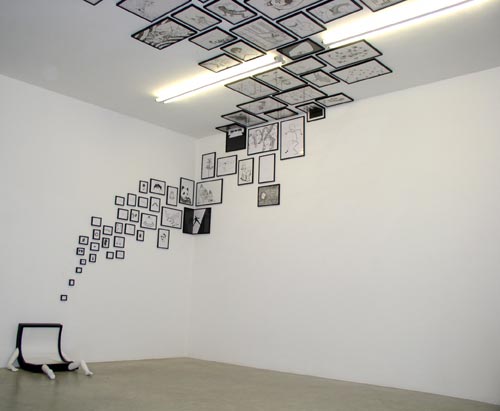
DIMS: installation view, approx 42"h x 8"d x 94"w / Materials: wood
Timothy Berg


Installation view, Hope Springs Eternal, 2007
Timothy Berg


Installation view, Hope Springs Eternal, 2007
Timothy Berg


Installation view, Hope Springs Eternal, 2007
Timothy Berg


Installation view, Hope Springs Eternal, 2007
Timothy Berg

Braille Graffiti in Paris


French graffiti collective 'The Blind'
via wooster

Peter Coffin


Peter Coffin | 08/09/2007 - 11/10/2007
Lieu d'exposition : 76, rue de Turenne 75003 Paris
Galerie Emmanuel Perrotin

Thursday, September 13

Design Tools


with Assist

Sémiologie Graphique by Jacques Bertin Part 2


Figure 2-4: Bertin's recommendations for visual attributes and perceptions


Figure 2-2: Bertin's table of representation and perception.

via Sympathico

Sémiologie Graphique by Jacques Bertin

En attendant Tufte

CompPanels: Images from the Annals of Composition

#26

Jacques Bertin and Vibratory Effects


Edward Tufte's books on visual information are so brilliant they have nearly eclipsed earlier work. But one publication shouldn't be overshadowed, Jacques Bertin's 1967 Sémiologie graphique.The University of Wisconsin Press published a translation in 1983: Semiology of Graphics: Diagrams, Networks, Maps. It's a splendid translation, with Bertin's masterful illustrations lovingly and faithfully rendered.

Aside from the erudition displayed, Bertin's book is distinguished by the rapport between text and illustration. Here's one of his graphics explaining "vibratory effect," that unpleasant optical phenomenon when certain combinations of black and white appear to our eyes as unstable, with gray or even colored patches that were not intended by the artist. Also known as "moiré," the shimmer is a physiological effect at the retinal level that seems to happen when our brain can't readily determine what is figure and what is ground. Bertin's illustration hopes to show this by displaying a systematic variation of bull's eyes. The vibratory effect should appear when the ratio of black to white area ranges from .4 to .6. In the diagram, that would be with figures located toward the middle. Clearly, the principles of moiré pertain to printed script as well as illustrations. Designers of typeface have long known to avoid letters that create a 50/50 ratio between black and white space.

Anybody have a copy of Semiology of Graphics they want to sell me at a reasonable price? Today on the used book market I can find only one 1983 University of Wisconsin Press copy for sale, and the seller is asking $295 for it. The reprint and softcover editions don't do justice to the orginal illustrations, I hear. Addendum (October 2004): A French correspondant tells me that in 1999 Editions de l'Ecole des Hautes Etudes en Sciences published a fine reprint of Sémiologie graphique with a new preface by Bertin, illustrations as good as the originals. You can find it for sale at 84 euros at amazon.fr.

RH, September 2004

via comppile

Fritz Panzer

arbeit1.jpg

Escalator by Fritz Panzer

Via VVORK

Things to look at


http://www.jaline.ca/external/ffffound/carparts.jpg

via FFFFOUND

The Non Planner Datebook


You can get it from Little Otsu

The Galapagos Post Office

Postoffice
Story by Seth Godin

Not sure what you can do with this story, but here you go:

On a deserted beach on a small island near the equator, there's a barrel and some ziploc bags. This post office has been here for more than a hundred years. It was built by whalers who needed a way to get letters home to England. The idea was that the last stop you would make on your way home was to the post office. You'd pick up whatever letters were there and bring them back to England.

I dropped two postcards in the barrel ten days ago (no stamps, of course). They arrived on Wednesday. I'm told some notes take as long as a month or two. Apparently, you can send a letter anywhere in the world and count on it showing up. There's actually a shortage of mail... more people want to carry the letters then write them.

Ideas spread in funny ways. In this case, the joy of the person who helps out by delivering the note is probably greater than that of the sender. And the story is so irresistible for both parties that it can't help but spread. By word of mouth or by blog...

The Art of Creating Creatures

More on Theo Jansen

Wednesday, September 12

Olafur Eliasson: Take your time @ SFMOMA (08/09/07 till 24/02/08)


Photo: Ian Reeves, courtesy SFMOMA


Photo: Drew Altizer Photography, courtesy SFMOMA

Images © Olafur Eliasson

Some Ads I grew up with

Bauhaus Photography


"This is the lovely and hard to find Gift Kodak No. 1A that was made for only one year 1930-31.
The Bauhaus-like motif is repeated on the camera and the enamel and metal inlay on the wooden box. While this camera..."


via M.appeal

Power of Ten by Charles and Ray Eames

Tapes and Bones


Let's hope Brian Dettmer can do as well as Damien Hirst on this one

Anne de Vries


Smash a rainbow, 2007, Anne de Vries

Signs


Cute Dutch Signs

Business Cards

Say Hello


The one below is from rodger beekman at mcann-eriksson in holland (1997)... for a dentist, sweet (tooth)


via Martyn Piper

Tuesday, September 11

Road to..........

Wieden + Kennedy

I really like the No Parking signs out of their office

Have you seen this one before


via Monoscope