
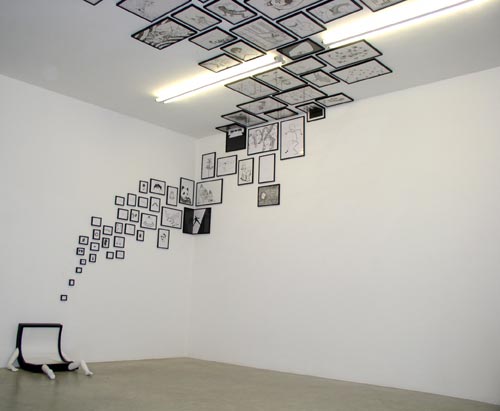


via FFFFOUND

On a deserted beach on a small island near the equator, there's a barrel and some ziploc bags. This post office has been here for more than a hundred years. It was built by whalers who needed a way to get letters home to England. The idea was that the last stop you would make on your way home was to the post office. You'd pick up whatever letters were there and bring them back to England.
I dropped two postcards in the barrel ten days ago (no stamps, of course). They arrived on Wednesday. I'm told some notes take as long as a month or two. Apparently, you can send a letter anywhere in the world and count on it showing up. There's actually a shortage of mail... more people want to carry the letters then write them.
Ideas spread in funny ways. In this case, the joy of the person who helps out by delivering the note is probably greater than that of the sender. And the story is so irresistible for both parties that it can't help but spread. By word of mouth or by blog...


There is a mood abroad, often fostered by non-blogging planners, that the emergence and popularity of planning blogs is killing the discipline.
I certainly feel that the community, like all communities, has begun to coalesce around specific 'new marketing' ideas that are in danger of becoming an orthodoxy every bit as dangerous as the antiquated ideas about brands and communications that it is seeking to replace. Specifically it encourages a view that the marketing landscape has already reached a kind of utopian future without offering any clues about how brands and the clients that own them should get there.
But is blogging really 'killing' planning?
This topic first came up in an email from Grey planning chief John Lowery, who raised his concerns about the potentially corrosive nature of blogging.
"One thing I noticed as I hyperleapt from one planning blog to another was an almost total lack of quantification of anything anyone said, at all. To that extent I thought perhaps one could make a case that blogging is killing planning, or at least planning as I know it. The publication of baseless pontification has, it seems, been democratised and offered up as a glamorous new role-model to a whole generation of 'planners' who wouldn't know what a tracking study questionnaire (not to mention an awareness index) was if it bit them in their left hemisphere".
And I have certainly heard a version of this argument at Coffee Morning, particularly from planners like John Griffiths. His concern is specifically that the pannersphere looks like a brilliant training resource but it fails to discuss or encourage the development of core craft skills.
While I do have some sympathy with this view (most notably that the content of planning blogs tends to be around the more 'out there' thinking that we do in our day to day jobs), after nearly two years and just over 100 posts I can't help thinking that blogging is the best thing that has happened to planners since Moleskine notebooks.
So in a spirit of 'what has blogging ever done for us' here are the reasons I think it is important for our discipline.
1. Community and networking
Blogging has created a planning community online (I call it the Plannersphere) that provides introductions and builds close ties within the discipline based primarily on the commodity we value most highly - how people think. And while this community is strongly represented in traditional planning industries and territories, where considerable mutual support already exists, it obviously works for those planners that work in places where our kind are rather thin on the ground. Whether they are in industries outside advertising or countries outside the planning hotspots. Indeed as a bunch of people who often shy away from traditional networking and schmoozing it has filled a very valuable need amongst planners.
2. Beta testing thinking
Every good planner thinks constantly about brands and communications, but unless this has direct and immediate relevance to their accounts it goes no further than an internal dialogue or idle banter with planning collegues.
The Plannersphere provides a place to crystallise and air thinking for others to build on or contest before it is aired more formally. But more than that it represents a group of people that are interested in your brand thinking no matter how rudimentary, people that encourage you and drive you on.
3. Collective intelligence
I reckon we are getting smarter as a result of the plannersphere. In nearly 20 years in the business I have never experienced as much intellectual stimulation and intense conversation as I have over the past 18 months - both because of thinking that exists on line and offline stimulus that it has led me to. New ideas, however ill formed at first, spread with ferocious speed at the moment making you aware of all sorts of thinking and giving you the ability to contribute to it. Transmedia Planning from Faris and Brand Enthusiasm from John being two clear and very recent examples.
4. Training and education
OK so the plannersphere isn't hot on the craft skills, although it is interesting that Russell's Account Planning School of the Web has gone back to basics more recently to try and respond to this criticism, but the plannersphere is incredibly successful at knowledge sharing. On a daily basis seriously good people are falling over themselves to give away their intellectual property or simply share a new campaign or brand they are interested in. It may not be providing the 3 Rs of planning but you'd be a fool if you were starting and you weren't consumming your body weight in wisdom from selected planning blogs.
More than that, by showcasing thinking at its very best we can help to teach emerging planners the standards that are expected of great strategic thinking beyond the approach or expectations of their current environment.
5. Influence and profile
Planners rarely hug or hog the limelight - I guess we are just built differently to your average account handler or creative. I have often joked that it is only planners that blog in advertising because account people have nothing to say and creatives have better places to say it but maybe its more that blogging was built for us. Creatives have their work and by and large that speaks for itself, account handlers their client relationships and the revenue they sit on or win but planners never really had much of an outlet to show how good they were (although the APG and AAAAs Jay Chiat awards have helped). Blogging has given us planners a way to show we are good and create influence within our agencies, the broader community and potentally with our clients.
6. Effortless internationalism
After years on international business stubbornly failing to understand anything going on outside the M25 I love the way that blogging makes you instinctively international as a planner. You see work from around the world easily and without cost, you are read throughout the world (albeit shamefully the blogs I read in return are English language) and your comments come from people throughout the world. In an industry that has always had a ugly strand of national arrogance running through it (particularly in the UK) blogging and the tools we use to bring our blogs to life (like you tube and flickr) are pulling down national barriers in the communications business.
As far as I am concerned, the plannersphere has created a kind of intellectual soup for a global community of brand thinkers to feed off, contribute to and create value from. As such it is and has the power to significantly improve the quality of planners and planning in the brand advice business.
For my money blogging and planning are a marriage made in heaven.
(P.S.) Since I wrote this I have been pointed at Hugh's thought about what makes a good blog. Seriously worth a read.
via adliterate


 Myoung Hoo Lee, Tree 1, 2007


The poetic language of Finn Geipel and Giulia Andi has transformed an ex-submarine base on the coast of Loire Atlantique into a space for music and contemporary art. Design by Finn Geipel, Giulia Andi (LIN). Text by Rita Capezzuto. Photos by Christoph Kicherer.
With Les vacances de Monsieur Hulot, in 1951, Jacques Tati was perhaps the first personality to present a brighter picture of an otherwise somewhat gloomy Saint-Nazaire. Albeit in ironic and melancholy tones, the film gave the Breton city the air of being more of a seaside holiday location. It helped to redeem its image, rooted in the minds of the French themselves as a dull place with a difficult history: a city of sailors and of workers employed in its local heavy industries, afflicted with rough Atlantic weather and almost totally destroyed by World War II. It also holds the sad record of having been the last city to be liberated in Europe, three days after the signing of the armistice in Berlin.
Today, the slogan adopted by the city council in its pledge to boost interest in local attractions and resources is “Saint-Nazaire: l’énergie Atlantique est là”. Competition with its rapidly developing neighbour Nantes is also a big factor in the publicity drive. The catchphrase nicely sums up the revitalisation programme that the small city on the Loire estuary launched in 1990 with its Projet Global de Développement. After a long period of crisis and with admirable far-sightedness, its administrators set out to rethink the framework of the city’s physical urban expansion, the strengthening of its main industrial resources (naval shipyards and aeronautical works), and new prospects for social and cultural life.
In recent years, the 67,000 inhabitants of Saint-Nazaire have witnessed an expansion of residential and tertiary areas and their related services and infrastructure, plus an experimental effort to reconnect the city centre to its truly vocational maritime strip. Furthermore, they have shared an articulated system of cultural initiatives that centred mainly on the contemporary and have been cleverly filtered into the existing built fabric. No major eye-catching architectural attraction has been commissioned to contain the numerous projects aimed at a differentiated public. Instead they have all been adequately housed in suitably converted historic buildings. One need only mention the annual world music festival Les Escales, which draws up to 40,000 spectators; the Fanal, an acclaimed centre for performances of theatre, song, circus, variety and dance; and the Grand Café and its services to contemporary art; or the Meet (house for foreign writers and translators), where international intellectuals gather to exchange views.
In this sense the mental, not the physical landscape of Saint-Nazaire has been transformed. The Bilbao model was rejected in favour of the easier but also conceptually subtler line previously pursued in Paris at the Palais de Tokyo, refurbished with invisible touches by Lacaton & Vassal as an interdisciplinary place dedicated to contemporary creation; or that of Karlsruhe and its ZKM, the Centre for arts and media, installed in a substantially unaltered ex-arms and munitions factory.
In Saint-Nazaire there is one particular old building, situated in the port, which as part of this cultural strategy of circular reuse has now been reintegrated into the life of the city after years of abandonment. A monument sui generis, it comprises a 480,000- cubic-metre concrete block, cast in a parallelepiped 299 metres long, 124 metres wide and 18 metres high. Instantly identifiable as a bunker, it was built by the German navy during World War II as one of its most important U-boat bases along the Atlantic coast of occupied France.
This impenetrable obstacle between the city and the sea is, in the opinion of many, an “uneasy” place. The building today projects the forceful image of a metaphor, clearly seized by local government when gauging the possibility of its inclusion and reuse. Back in 1998, Manuel de Solá- Morales, winner of a competition for the area, had envisioned its reuse as a public facility to be opened towards the sea, with shopping and eating areas, a large car park and a street ramp leading up to a practicable roof. Only some of these proposals were later realised, such as access to the roof, perhaps its most significant urban feature. But the city council’s vision has remained consistent since then, though with more realistic compromises to allow real improvements and progressive transformations of the complex identified by phases, with works expected to be completed by 2012.
In 2003 a new competition focused on the so-called “Alvéole 14”, one of the floating dock berths for two submarines, with service rooms on the landside. The brief specified the creation of a LiFE unit (International Place of Emergent Forms) and a VIP room (stage for performances of contemporary music), with a total surface area of 5,500 square metres.
The young Franco-Berliner firm LIN, formed by winners Finn Geipel and Giulia Andi, has interpreted the historical memory of the place with respectful awareness, by working on the present enigmatic nature of its spaces and on the simplicity of their circulation. A wide straight promenade, identified by a regular and light rain of suspended lights, distributes with silent discretion the “caves” of thick reinforced concrete that have remained in their brutally original state – infiltrations of water and old writings included. This inner street, which also in the original design ran perpendicular to all 14 dry docks, still shows traces of the rail tracks that carried wagons transporting heavy equipment.
There are almost no newly superimposed elements at all in the project, apart from the odd metal staircase or systems pipes. An air of liberating detachment can be sensed. Any ethical question of whether or not to conserve and reuse episodes of Nazi history is brushed aside, even though the issue is to this day a deeply contentious one among German as well as other historians and politicians. The LIN project, however, has added a pleasantly refreshing surprise among so much rigour. Mounted on the roof of the Alvéole 14 section is a translucent, geodetic cupola, transferred from Berlin’s Tempelhof airport where it had housed a disused radar. At Saint-Nazaire it is now a think tank, a compact experimental laboratory. Illuminated by night, it signals to the city that something new has happened in the bunker.


